
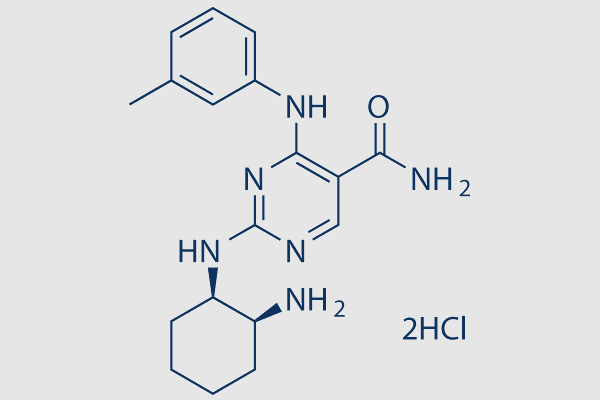
[CAS NO. 1194961-19-7] PRT-060318 2HCl
Please click "REQUEST A QUOTE" button if you need other sizes or custom synthesis
request a quote
If there is no stock, or you need other sizes or custom synthesis, please:
PRODUCTS SPECIFICATIONS [1194961-19-7]
Store

Catalog
SLK-S7738
Brand
Selleck
CAS
1194961-19-7
DESCRIPTION [1194961-19-7]
Overview
| MDL | MFCD28155088 |
|---|---|
| Molecular Weight | 413.34 |
| Molecular Formula | C18H24N6O.2HCl |
| SMILES | O=C(C1=CN=C(N[C@H]2[C@@H](N)CCCC2)N=C1NC3=CC=CC(C)=C3)N |
For research use only.
Storage
3 years,-20°C,powder
1 years,-80°C,in solvent
1 years,-80°C,in solvent
Shipping
Room temperature shipping(Stability testing shows this product can be shipped without any cooling measures.)
Preparing Stock Solutions
| 1 mg | 5 mg | 10 mg | |
| 1 mM | 2.4193 mL | 12.0966 mL | 24.1932 mL |
| 5 mM | 0.4839 mL | 2.4193 mL | 4.8386 mL |
| 10 mM | 0.2419 mL | 1.2097 mL | 2.4193 mL |
| 50 mM | 0.0484 mL | 0.2419 mL | 0.4839 mL |
Description
PRT-060318 (PRT318) is a novel selective inhibitor of the with an IC50 of 4 nM, as an approach to HIT treatment.
Targets
| Syk [1] (Cell-free assay) |
| 4nM |
In vitro
PRT318 inhibits platelet activation via GPVI/FcRγ, an ITAM receptor complex, but not via ADP or thrombin, which are G-protein coupled receptors. PRT318 effectively antagonizes CLL(chronic lymphocytic leukemia) cell survival after BCR triggering and in nurse-like cell-co-cultures. PRT318 inhibits Syk and extracellular signal-regulated kinase phosphorylation after BCR triggering.
In vivo
In both rabbit and pig models, intravenous infusion of PRT060318 targets maximal inhibition of Syk kinase activity and significantly inhibits arterial thrombosis. The antithrombotic activity of PRT060318 in pigs is remarkable because it was achieved with complete inhibition of CVXN-induced platelet aggregation, with no effect on ADP-induced platelet aggregation, and no prolongation of ear bleeding time. Also, Syk inhibitor PRT318 is an active agent in HIT. Inhibition of Syk signaling with the orally bio-available PRT318 limits the thrombocytopenic and thrombotic effects of HIT IC in vivo.
References

Powered by Arctom Copyright © 2026 Arctom. All rights
reserved.