
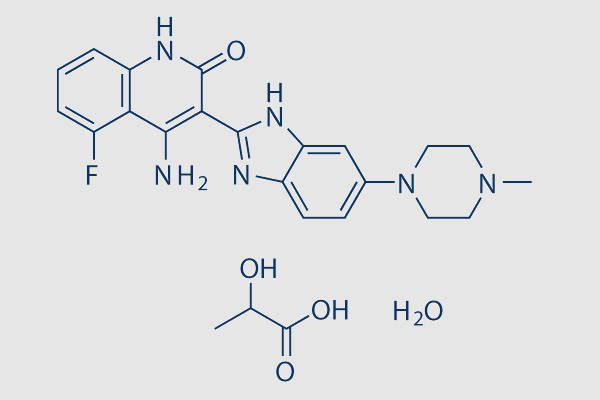
[CAS NO. 915769-50-5] Dovitinib (TKI258) Lactate monohydrate
Please click "REQUEST A QUOTE" button if you need other sizes or custom synthesis
request a quote
If there is no stock, or you need other sizes or custom synthesis, please:
PRODUCTS SPECIFICATIONS [915769-50-5]
Store

Catalog
SLK-S7765
Brand
Selleck
CAS
915769-50-5
DESCRIPTION [915769-50-5]
Overview
| MDL | MFCD16038433 |
|---|---|
| Molecular Weight | 500.52 |
| Molecular Formula | C24H29FN6O5 |
| SMILES | O=C1NC2=C(C(F)=CC=C2)C(N)=C1C3=NC4=CC=C(N5CCN(C)CC5)C=C4N3.CC(O)C(O)=O.[H]O[H] |
For research use only.
Storage
3 years,-20°C,powder
1 years,-80°C,in solvent
1 years,-80°C,in solvent
Shipping
Room temperature shipping(Stability testing shows this product can be shipped without any cooling measures.)
Preparing Stock Solutions
| 1 mg | 5 mg | 10 mg | |
| 1 mM | 1.9979 mL | 9.9896 mL | 19.9792 mL |
| 5 mM | 0.3996 mL | 1.9979 mL | 3.9958 mL |
| 10 mM | 0.1998 mL | 0.9990 mL | 1.9979 mL |
| 50 mM | 0.0400 mL | 0.1998 mL | 0.3996 mL |
Description
Dovitinib (TKI258) Lactate monohydrate is the Lactate of Dovitinib, which is a multitargeted RTK inhibitor, mostly for class III () with of 1 nM/2 nM, also potent to class IV () and class V () RTKs with of 8-13 nM, less potent to InsR, EGFR, c-Met, EphA2, Tie2, IGFR1 and HER2. Phase 4.
Targets
In vitro
Dovitinib potently inhibits the FGF-stimulated growth of WT and F384L-FGFR3-expressing B9 cells with IC50 of 25 nM. In addition, Dovitinib inhibits proliferation of B9 cells expressing each of the various activated mutants of FGFR3. Interestingly, there are minimal observed differences in the sensitivity of the different FGFR3 mutations to Dovitinib, with the IC50 ranging from 70 to 90 nM for each of the various mutations. IL-6-dependent B9 cells containing vector only (B9-MINV cells are resistant to the inhibitory activity of Dovitinib at concentrations up to 1 μM. Dovitinib inhibits cell proliferation of KMS11 (FGFR3-Y373C), OPM2 (FGFR3-K650E), and KMS18 (FGFR3-G384D) cells with IC50 of 90 nM (KMS11 and OPM2) and 550 nM, respectively. Dovitinib inhibits FGF-mediated ERK1/2 phosphorylation and induces cytotoxicity in FGFR3-expressing primary MM cells. BMSCs does confer a modest degree of resistance with 44.6% growth inhibition for cells treated with 500 nM Dovitinib and cultured on stroma compared with 71.6% growth inhibition for cells grown without BMSCs. Dovitinib inhibits proliferation of M-NFS-60, an M-CSF growth-driven mouse myeloblastic cell line with a median effective concentration (EC50) of 220 nM. Treatment of SK-HEP1 cells with Dovitinib results in a dose-dependent reduction in cell number and G2/M phase arrest with reduction in the G0/G1 and S phases, inhibition of anchorage-independent growth and blockage of bFGF-induced cell motility. The IC50 for Dovitinib in SK-HEP1 cells is approximately 1.7 μM. Dovitinib also significantly reduces the basal phosphorylation levels of FGFR-1, FGFR substrate 2α (FRS2-α) and ERK1/2 but not Akt in both SK-HEP1 and 21-0208 cells. In 21-0208 HCC cells, Dovitinib significantly inhibits bFGF-induced phosphorylation of FGFR-1, FRS2-α, ERK1/2 but not Akt.
References

Powered by Arctom Copyright © 2026 Arctom. All rights
reserved.