
[CAS NO. 1232030-35-1] FRAX486
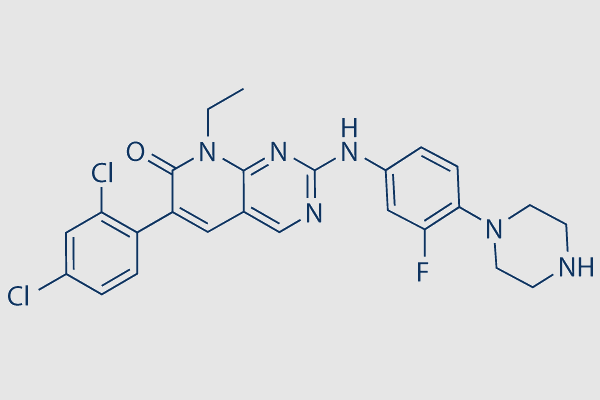
Please click "REQUEST A QUOTE" button if you need other sizes or custom synthesis
request a quote
If there is no stock, or you need other sizes or custom synthesis, please:
PRODUCTS SPECIFICATIONS [1232030-35-1]
Store

Catalog
SLK-S7807
Brand
Selleck
CAS
1232030-35-1
DESCRIPTION [1232030-35-1]
Overview
| MDL | - |
|---|---|
| Molecular Weight | 513.39 |
| Molecular Formula | C25H23Cl2FN6O |
| SMILES | O=C1C(C2=CC=C(Cl)C=C2Cl)=CC3=CN=C(NC4=CC=C(N5CCNCC5)C(F)=C4)N=C3N1CC |
For research use only.
Storage
3 years,-20°C,powder
1 years,-80°C,in solvent
1 years,-80°C,in solvent
Shipping
Room temperature shipping(Stability testing shows this product can be shipped without any cooling measures.)
Preparing Stock Solutions
| 1 mg | 5 mg | 10 mg | |
| 1 mM | 1.9478 mL | 9.7392 mL | 19.4784 mL |
| 5 mM | 0.3896 mL | 1.9478 mL | 3.8957 mL |
| 10 mM | 0.1948 mL | 0.9739 mL | 1.9478 mL |
| 50 mM | 0.0390 mL | 0.1948 mL | 0.3896 mL |
Description
FRAX486 is a potent inhibitor with IC50 values of 14, 33, 39 and 575 nM for PAK1, PAK2, PAK3 and PAK4 respectively.
Targets
In vitro
In WPMY-1 cells, FRAX486 induces concentration-dependent (1-10 μM) degeneration of actin filaments. This was paralleled by attenuation of proliferation rate, being observed from 1 to 10 μM FRAX486. Cytotoxicity of FRAX486 in WPMY-1 cells is time- and concentration-dependent. In WPMY-1 cells, effects of FRAX486 on actin organization, survival, and proliferation occurred already at concentrations of 1-5 μM. In these concentrations, full inhibition of PAK1-3 may be expected, while PAK4 may be inhibited only partially.
In vivo
FRAX486 crosses the blood-brain barrier and that therapeutically useful concentrations of FRAX486 are in the brain as early as 1 h and remain as long as 24 h after administration, with the maximum concentration in the target tissue at 8 h. Daily dosing results in steady-state levels of FRAX486 in the brain. FRAX486 specifically rescues the Fmr1 KO abnormality in which the spine phenotype is present in apical neurons and not simply decreasing spine density irrespective of genotype or existence of a phenotype. Also, FRAX486 reduces hyperactivity and stereotypical movements, both of which are phenotypes that characterize the mouse model of Fragile X syndrome.
References

Powered by Arctom Copyright © 2026 Arctom. All rights
reserved.