
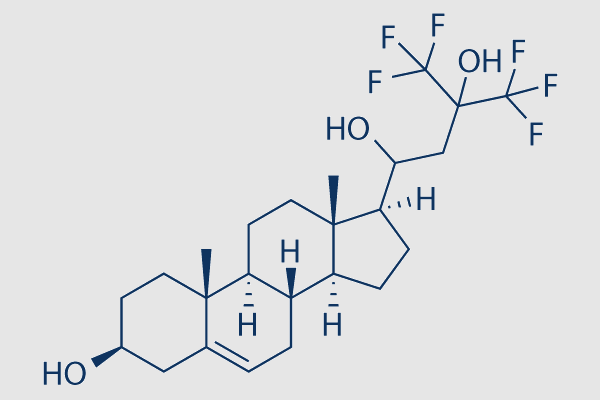
[CAS NO. 102586-30-1] NSC12
Please click "REQUEST A QUOTE" button if you need other sizes or custom synthesis
request a quote
If there is no stock, or you need other sizes or custom synthesis, please:
PRODUCTS SPECIFICATIONS [102586-30-1]
Store

Catalog
SLK-S7940
Brand
Selleck
CAS
102586-30-1
DESCRIPTION [102586-30-1]
Overview
| MDL | - |
|---|---|
| Molecular Weight | 484.52 |
| Molecular Formula | C24H34F6O3 |
| SMILES | - |
For research use only.
Storage
3 years,-20°C,powder
1 years,-80°C,in solvent
1 years,-80°C,in solvent
Shipping
Room temperature shipping(Stability testing shows this product can be shipped without any cooling measures.)
Preparing Stock Solutions
| 1 mg | 5 mg | 10 mg | |
| 1 mM | 2.0639 mL | 10.3195 mL | 20.6390 mL |
| 5 mM | 0.4128 mL | 2.0639 mL | 4.1278 mL |
| 10 mM | 0.2064 mL | 1.0319 mL | 2.0639 mL |
| 50 mM | 0.0413 mL | 0.2064 mL | 0.4128 mL |
Description
NSC12 (NSC 172285) is an orally available pan-FGF trap able to inhibit interaction and endowed with promising antitumor activity.
Targets
In vitro
NSC12 inhibits FGF-dependent tumor growth, angiogenesis, and metastases. NSC12 does not affect FGF2/heparin interaction, whereas it inhibits the binding of FGF2 to the immobilized receptor (ID50 ∼30 μM). NSC12 interferes with FGF2/FGFR1 interaction without affecting the ability of the growth factor to interact with heparin or HSPGs. NSC12 also binds immobilized FGF3, FGF4, FGF6, FGF8, FGF16, FGF18, FGF20, and FGF22 with Kd values ranging between ∼16 and ∼120 μM. NSC12 may act as a multi-FGF trap by interacting with all members of the canonical FGF subfamilies. NSC12 hampers FGF23-mediated FGFR1 activation in Klotho-expressing Chinese hamster ovary (CHO) cells. Treatment with NSC12 causes the reduction of the S phase of the cell cycle in all tumor cell lines but LLC cells, in which an accumulation in the S phase is observed. NSC12 inhibits FGFR1, FGFR2, FGFR3, and FGFR4 phosphorylation in CHO cell transfectants. NSC12 inhibits the proliferation of various FGF-dependent murine and human cancer cell lines with no inhibitory effect on HCC827 cancer cells that harbor a tumor-driving mutation of the EGFR TK domain and on FGF-independent cancer cell lines.
In vivo
Parenteral and oral delivery of NSC12 inhibits FGFR activation, tumor growth, angiogenesis, and metastasis in FGF-dependent murine and human tumor models. NSC12 causes a significant decrease of tumor weight, tumor cell FGFR1 phosphorylation and proliferation, and tumor CD31+ neovascularization at all the doses tested in the animal models.

Powered by Arctom Copyright © 2026 Arctom. All rights
reserved.