
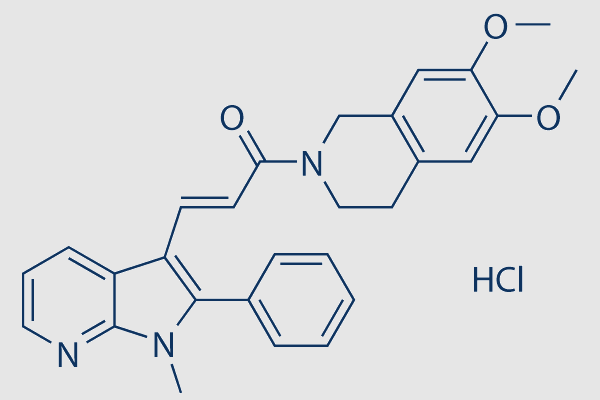
[CAS NO. 521984-48-5] SIS3 HCl
Please click "REQUEST A QUOTE" button if you need other sizes or custom synthesis
request a quote
If there is no stock, or you need other sizes or custom synthesis, please:
PRODUCTS SPECIFICATIONS [521984-48-5]
Store

Catalog
SLK-S7959
Brand
Selleck
CAS
521984-48-5
DESCRIPTION [521984-48-5]
Overview
| MDL | MFCD09265258 |
|---|---|
| Molecular Weight | 489.99 |
| Molecular Formula | C28H27N3O3.HCl |
| SMILES | O=C(N1CC2=C(C=C(OC)C(OC)=C2)CC1)/C=C/C3=C(C4=CC=CC=C4)N(C)C5=NC=CC=C53.[H]Cl |
For research use only.
Storage
3 years,-20°C,powder
1 years,-80°C,in solvent
1 years,-80°C,in solvent
Shipping
Room temperature shipping(Stability testing shows this product can be shipped without any cooling measures.)
Preparing Stock Solutions
| 1 mg | 5 mg | 10 mg | |
| 1 mM | 2.0409 mL | 10.2043 mL | 20.4086 mL |
| 5 mM | 0.4082 mL | 2.0409 mL | 4.0817 mL |
| 10 mM | 0.2041 mL | 1.0204 mL | 2.0409 mL |
| 50 mM | 0.0408 mL | 0.2041 mL | 0.4082 mL |
Description
SIS3, a novel specific inhibitor of , inhibits TGF-β and activin signaling by suppressing Smad3 phosphorylation without affecting the MAPK/p38, ERK, or PI3-kinase signaling pathways.
Targets
| Smad3 [1] |
In vitro
Addition of SIS3 attenuates the effects of TGF-β1 by reducing the transcriptional activity. SIS3 also inhibits the myofibroblast differentiation of fibroblasts by TGF-β1. SIS3 completely diminishes the constitutive phosphorylation of Smad3 as well as the up-regulated type I collagen expression in scleroderma fibroblasts, thus abolishes the ECM overexpression in the TGF-β1-treated normal dermal fibroblasts and scleroderma fibroblasts in vitro.
In vivo
SIS3 inhibits Smad3 activation in streptozotocin(STZ)-induced diabetic nephropathy in Tie2-Cre;Loxp-EGFP mice. It also reduces AGE-induced EndoMT and decreases EndoMT in STZ-induced diabetic nephropathy in Tie2-Cre;Loxp-EGFP mice. SIS3 significantly reduces collagen IV and fibronectin expression in the glomeruli and tubulointerstitium of STZ-injected Tie2-Cre;Loxp-EGFP mice, suggesting that SIS3 retards the early development of STZ-induced diabetic glomerulosclerosis and tubulointerstitial fibrosis. However, SIS3 administration does not reduce proteinuria.
References

Powered by Arctom Copyright © 2026 Arctom. All rights
reserved.