
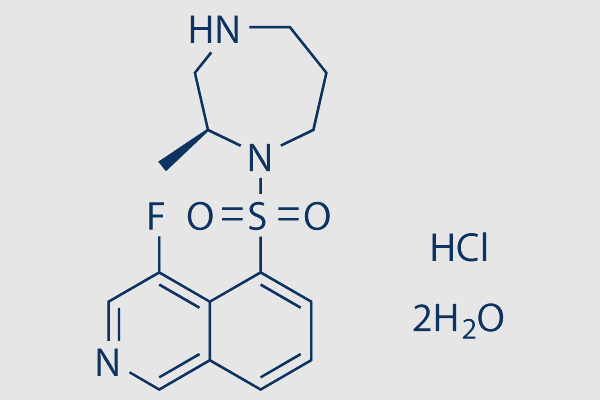
[CAS NO. 887375-67-9] Ripasudil (K-115) hydrochloride dihydrate
Please click "REQUEST A QUOTE" button if you need other sizes or custom synthesis
request a quote
If there is no stock, or you need other sizes or custom synthesis, please:
PRODUCTS SPECIFICATIONS [887375-67-9]
Store

Catalog
SLK-S7995
Brand
Selleck
CAS
887375-67-9
DESCRIPTION [887375-67-9]
Overview
| MDL | MFCD26960897 |
|---|---|
| Molecular Weight | 395.88 |
| Molecular Formula | C15H18FN3O2S.Cl H.2 H2 O |
| SMILES | O=S(C1=CC=CC2=C1C(F)=CN=C2)(N3[C@@H](C)CNCCC3)=O.[H]O[H].[H]O[H].[H]Cl |
For research use only.
Storage
3 years,-20°C,powder
1 years,-80°C,in solvent
1 years,-80°C,in solvent
Shipping
Room temperature shipping(Stability testing shows this product can be shipped without any cooling measures.)
Preparing Stock Solutions
| 1 mg | 5 mg | 10 mg | |
| 1 mM | 2.5260 mL | 12.6301 mL | 25.2602 mL |
| 5 mM | 0.5052 mL | 2.5260 mL | 5.0520 mL |
| 10 mM | 0.2526 mL | 1.2630 mL | 2.5260 mL |
| 50 mM | 0.0505 mL | 0.2526 mL | 0.5052 mL |
Description
Ripasudil (K-115) hydrochloride dihydrate is potent inhibitor with of 51 nM and 19 nM for ROCK1 and ROCK2, respectively, used for the treatment of glaucoma and ocular hypertension.
In vitro
In monkey trabecular meshwork (TM) cells, Ripasudil induces retraction and rounding of cell bodies as well as disruption of actin bundles. In Schlemm's canal endothelial (SCE) cells, Ripasudil significantly decreases transendothelial electrical resistance (TEER), increases the transendothelial flux of FITC-dextran, and disrupts cellular localization of ZO-1 expression.
References

Powered by Arctom Copyright © 2026 Arctom. All rights
reserved.