
[CAS NO. 487-52-5] Butein
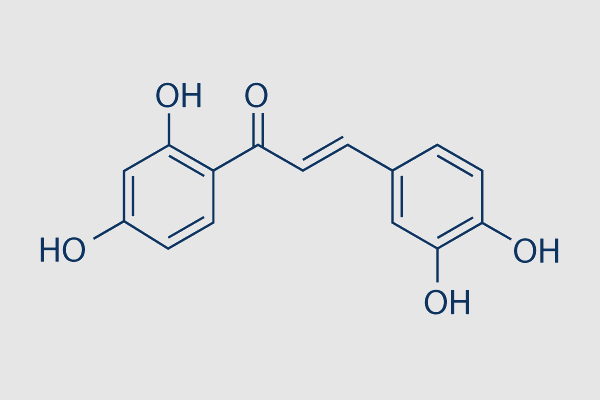
Please click "REQUEST A QUOTE" button if you need other sizes or custom synthesis
request a quote
If there is no stock, or you need other sizes or custom synthesis, please:
PRODUCTS SPECIFICATIONS [487-52-5]
Store

Catalog
SLK-S8036
Brand
Selleck
CAS
487-52-5
DESCRIPTION [487-52-5]
Overview
| MDL | MFCD00017300 |
|---|---|
| Molecular Weight | 272.25 |
| Molecular Formula | C15H12O5 |
| SMILES | C(/C=C/C1=CC(O)=C(O)C=C1)(=O)C2=C(O)C=C(O)C=C2 |
For research use only.
Storage
3 years,-20°C,powder
1 years,-80°C,in solvent
1 years,-80°C,in solvent
Shipping
Room temperature shipping(Stability testing shows this product can be shipped without any cooling measures.)
Preparing Stock Solutions
| 1 mg | 5 mg | 10 mg | |
| 1 mM | 3.6731 mL | 18.3655 mL | 36.7309 mL |
| 5 mM | 0.7346 mL | 3.6731 mL | 7.3462 mL |
| 10 mM | 0.3673 mL | 1.8365 mL | 3.6731 mL |
| 50 mM | 0.0735 mL | 0.3673 mL | 0.7346 mL |
Description
Butein, a plant polyphenol isolated from , is able to inhibit the activation of protein tyrosine kinase, and , also inhibits .
Targets
| EGFR [1] |
In vitro
Butein inhibits the epidermal growth factor (EGF)-stimulated auto-phosphotyrosine level of EGF receptor in HepG2 cells, and also inhibits tyrosine-specific protein kinase activities of EGF receptor and p60 with IC50 of 65 μM in vitro. The inhibition is competitive to ATP and non-competitive to the phosphate acceptor, poly (Glu, Ala, Tyr) 6:3:1 for EGF receptor tyrosine kinase. In contrast, Butein non-significantly inhibits the activities of serine- and threonine-specific protein kinases such as PKC or PKA.
Butein inhibits Nuclear Factor(NF)-κB and NF-κB-regulated gene expression through direct inhibition of IκBα Kinase β on Cysteine 179 Residue. Butein (10 μM) inhibits over 90% iNOS and COX-2 expression, as well as nitrite and TNF-α production in LPS-stimulated RAW 264.7 cells. Butein (10 μM) inhibits LPS-induced DNA binding activity of NF-κB, which is mediated through inhibition of the degradation of inhibitory factor-κB and phosphorylation of Erk1/2 MAP kinase, as well as increases binding of the osteopontin a vb3 integrin receptor. Butein (20 μM) treatment induces morphologic changes of bladder cancer cells BLS(M) from elongated morphology to rounded epithelial-like cells, accompanied by downregulation of vimentin, and gaining of E-cadherin compared to untreated control cells, indicating the reversal of mesenchymal-like phenotype. Butein (20 μM) suppresses motility and invasion capacity of BLS(M) cells, and reverts EMT-like phenotype induced by TNF-α, through the ERK1/2 and NF-κB signaling pathways.
Butein inhibits the constitutive activation of STAT3 in HepG2 cells in a dose-dependent manner, with maximum inhibition occurring at 50 μM, mediated through the inhibition of activation of upstream kinases c-Src and Janus-activated kinase2. Butein (50 μM) also could completely inhibit IL-6-induced STAT3 phosphorylation in SNU-387 cells. Butein downregulates the expression of cyclin D1, Bcl-2, Bcl-xL, survivin, and VEGF, markers of STAT3 activation. Butein (50 μM) significantly enhance the apoptotic effects of doxorubicin from 18% to 55% and of paclitaxel from 15% to 42%.
Butein is as a powerful antioxidant against lipid and LDL peroxidation. Butein inhibits iron-induced lipid peroxidation in rat brain homogenate with an IC50 of 3.3 μM. Butein is as potent α-tocopherol in reducing the stable free radical diphenyl-2-picrylhydrazyl (DPPH) with IC0.2 of 9.2 μM. Butein also inhibits the activity of xanthine oxidase with an IC50 of 5.9 μM. Butein scavenges the peroxyl radical derived from 2,2-azobis(2-amidinopropane) dihydrochloride (AAPH) in aqueous phase. Furthermore, Butein inhibits copper-catalyzed oxidation of human low-density lipoprotein (LDL) in a concentration-dependent manner. Butein is a chelator of ferrous and copper ions.
In vivo
Butein at 2 mg/kg induces significant inhibition of hepatocellular tumor growth compared with the corn oil-treated controls. At necropsy on day 22 after initial treatment, there is more than 2-fold decrease in tumor growth in the Butein-treated group (mean relativetumor burden, 3.90) compared with the control group (8.46), associated with reduced constitutive p-STAT3 (9% vs 81% of vehicle group), Bcl-2 levels (26% vs 96% of vehicle group), and increased caspase-3 level (98% vs 21% of vehicle group) in HCC tumor tissues.
Butein shows antifibrogenic activity. Butein (25 mg/kg/day) reduces serum AST and ALT activation to 35% and 69%, respectively, of control CCl-induced rat levels. Butein (25 mg/kg/day) reduces liver hydroxyproline contents and TBAR4 concentration to 54% and 54%, respectively. α1(I) collagen and TIMP-1 expression in Butein-treated rats is 28% and 20.3% compared with the values for the respective CCl-treated control.
References
[1] Yang EB, et al. Biochem Biophys Res Commun, 1998, 17, 245(2), 435-438.
[2] Pandey MK, et al. J Biol Chem, 2007, 282(24), 17340-17350.
[3] Lee SH, et al. Biochem Biophys Res Commun, 2004 , 323(1), 125-132.
[4] Zhang L, et al. FEBS Lett, 2008, 582(13), 1821-1828.
[5] Rajendran P, et al. Clin Cancer Res, 2011, 17(6), 1425-1439.
[6] Cheng ZJ, et al. Biochim Biophys Acta, 1998, 1392(2-3), 291-299.
[7] Lee SH, et al. Planta Med, 2003, 69(11), 990-994.
[2] Pandey MK, et al. J Biol Chem, 2007, 282(24), 17340-17350.
[3] Lee SH, et al. Biochem Biophys Res Commun, 2004 , 323(1), 125-132.
[4] Zhang L, et al. FEBS Lett, 2008, 582(13), 1821-1828.
[5] Rajendran P, et al. Clin Cancer Res, 2011, 17(6), 1425-1439.
[6] Cheng ZJ, et al. Biochim Biophys Acta, 1998, 1392(2-3), 291-299.
[7] Lee SH, et al. Planta Med, 2003, 69(11), 990-994.
Synonyms
2-Propen-1-one, 1-(2,4-dihydroxyphenyl)-3-(3,4-dihydroxyphenyl)-, (2E)-
Chalcone, 2′,3,4,4′-tetrahydroxy-
Butein
2-Propen-1-one, 1-(2,4-dihydroxyphenyl)-3-(3,4-dihydroxyphenyl)-, (E)-
(2E)-1-(2,4-Dihydroxyphenyl)-3-(3,4-dihydroxyphenyl)-2-propen-1-one
(E)-1-(2,4-Dihydroxyphenyl)-3-(3,4-hydroxyphenyl)prop-2-en-1-one

Powered by Arctom Copyright © 2026 Arctom. All rights
reserved.