
[CAS NO. 937272-79-2] Pacritinib (SB1518)
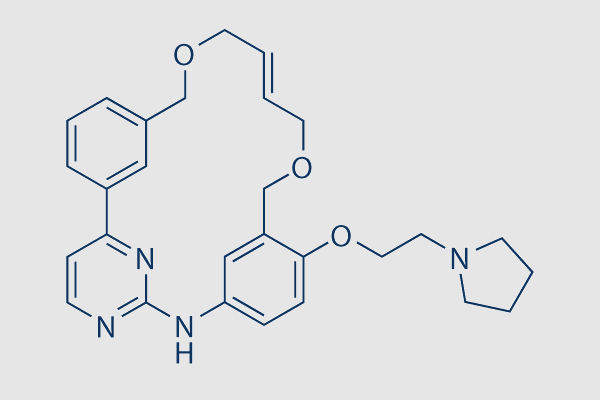
Please click "REQUEST A QUOTE" button if you need other sizes or custom synthesis
request a quote
If there is no stock, or you need other sizes or custom synthesis, please:
PRODUCTS SPECIFICATIONS [937272-79-2]
Store

Catalog
SLK-S8057
Brand
Selleck
CAS
937272-79-2
DESCRIPTION [937272-79-2]
Overview
| MDL | MFCD22572772 |
|---|---|
| Molecular Weight | 472.58 |
| Molecular Formula | C28H32N4O3 |
| SMILES | O(CCN1CCCC1)C=2C3=CC(N=C4NC(C=5C=C(C=CC5)COC/C=C/COC3)=CC=N4)=CC2 |
For research use only.
Storage
3 years,-20°C,powder
1 years,-80°C,in solvent
1 years,-80°C,in solvent
Shipping
Room temperature shipping(Stability testing shows this product can be shipped without any cooling measures.)
Description
Pacritinib (SB1518) is a potent and selective inhibitor of and with of 23 and 22 nM in cell-free assays, respectively. Phase 3.
Features
Dual JAK2/FLT3 inhibitor that has progressed to Phase III clinical trials for treatment of Myelofibrosis.
Targets
In vitro
Pacritinib is a potent inhibitor of both wild-type JAK2 and JAK2 mutant (IC50= 19 nM) that is present in high frequencies among patients with MPD. Relative to JAK2, Pacritinib is two-fold less potent against TYK2 (IC50= 50 nM), 23-fold less potent against JAK3 (IC50= 520 nM) and 56-fold less potent against JAK1 (IC50= 1280 nM). Pacritinib effectively permeates cells to modulate signaling pathways downstream of JAK2, whether agonist activated or mutationally activated. Pacritinib induces apoptosis, cell cycle arrest and antiproliferative effects in JAK2- and JAK2-dependent cells. Pacritinib inhibits cell proliferation of Karpas 1106P and Ba/F3-JAK2 with IC50 of 348 and 160 nM, respectively. Pacritinib inhibits endogenous colony growth derived from erythroid and myeloid progenitors with IC50 of 63 and 53 nM , respectively.
SB1518 also inhibits FLT3 and its mutant FLT3-D835Y(IC50= 6 nM ). Pacritinib inhibits FLT3 phosphorylation and downstream STAT, MAPK and PI3K signaling in FLT3-internal-tandem duplication (ITD), FLT3-wt cells and primary AML blast cells. Pacritinib treatment leads to a dose-dependent decrease of pFLT3, pSTAT5, pERK1/2 and pAkt in FLT3-ITD harboring MV4-11 cells with IC50 of 80, 40, 33 and 29 nM , respectively. Treatment of the primary AML blast cells with Pacritinib for 3 h leads to a dose-dependent decrease of pFLT3, pSTAT3 and pSTAT5 with an IC50 below 0.5 μM. Pacritinib induces apoptosis, cell cycle arrest and anti-proliferative effects in FLT3-mutant and FLT3-wt cells. Pacritinib inhibits cell proliferation of FLT3-ITD-harboring cells MV4-11 and primary AML blast cells with IC50s of 47 nM and 0.19-1.3 μM, respectively.
In vivo
Pacritinib administrated at 150 mg/kg p.o. q.d. to JAK2-dependent xenograft model, significantly ameliorates splenomegaly and hepatomegaly symptoms, with 60% normalization of spleen weight and 92% normalization of liver weight and is well tolerated without significant weight loss or any hematological toxicities, including thrombocytopenia and anemia. Pacritinib induces dose-dependent inhibition of tumor growth of JAK2-dependent SET-2 xenograft model (40% for 75 mg/kg and 61% for 150 mg/kg).
Pacritinib is efficacious in FLT3-ITD-bearing MV4-11 xenograft models. Pacritinib treated once daily for 21 consecutive days, induces dose-dependent inhibition of tumor growth (38% for 25 mg/kg, 92% for 50 mg/kg and 121% for 100 mg/kg). Complete regression is observed in 3/10 and 8/8 mice for the 50 and 100 mg/kg/day groups, respectively.
References
Synonyms
14,19-Dioxa-5,7,27-triazatetracyclo[19.3.1.12,6.18,12]heptacosa-1(25),2,4,6(27),8,10,12(26),16,21,23-decaene, 11-[2-(1-pyrrolidinyl)ethoxy]-, (16E)-
(16E)-11-[2-(1-Pyrrolidinyl)ethoxy]-14,19-dioxa-5,7,27-triazatetracyclo[19.3.1.12,6.18,12]heptacosa-1(25),2,4,6(27),8,10,12(26),16,21,23-decaene
Pacritinib
SB 1518

Powered by Arctom Copyright © 2026 Arctom. All rights
reserved.