
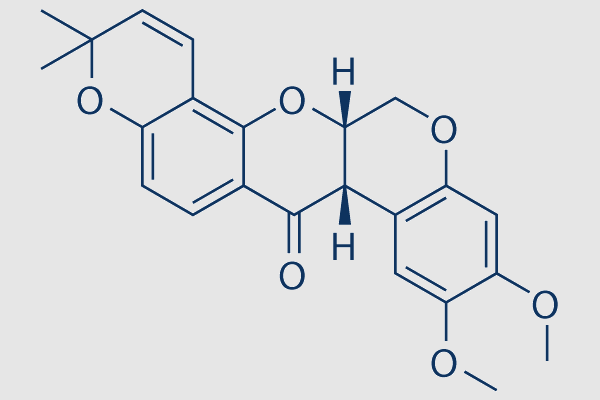
[CAS NO. 522-17-8] Deguelin
Please click "REQUEST A QUOTE" button if you need other sizes or custom synthesis
request a quote
If there is no stock, or you need other sizes or custom synthesis, please:
PRODUCTS SPECIFICATIONS [522-17-8]
Store

Catalog
SLK-S8132
Brand
Selleck
CAS
522-17-8
DESCRIPTION [522-17-8]
Overview
| MDL | MFCD01740600 |
|---|---|
| Molecular Weight | 394.42 |
| Molecular Formula | C23H22O6 |
| SMILES | O=C1C=2C(=C3C(=CC2)OC(C)(C)C=C3)O[C@]4([C@@]1(C=5C(OC4)=CC(OC)=C(OC)C5)[H])[H] |
For research use only.
Storage
3 years,-20°C,powder
1 years,-80°C,in solvent
1 years,-80°C,in solvent
Shipping
Room temperature shipping(Stability testing shows this product can be shipped without any cooling measures.)
Description
Deguelin, a natural product isolated from plants in the Mundulea sericea family, is an Inhibitor.
In vitro
Deguelin downregulates Akt phosphorylation in leukaemia cell lines with an active PI3K/Akt axis. At 10 or 100 nmol/l, deguelin is effective in inhibiting Akt phosphorylation. Total Akt expression is unchanged by deguelin. Moreover, deguelin does not affect the expression or the phosphorylation levels of either p44/42 or p38 MAP kinases in U937 cells. Deguelin increases sensitivity of human leukaemia cells to chemotherapeutic drugs. Deguelin dephosphorylates Akt and increases cytarabine sensitivity of AML blasts but not of CB CD34+. Deguelin, when employed for 24 h at 10 nmol/l, causes an S phase arrest of U937 cells, with interference of progression to G2/M phase. While employed alone up to a concentration of 10 nmol/l for 24 h, Deguelin does not significantly increase the apoptotic rate of U937 cells.
In vivo
Deguelin inhibits in vivo angiogenesis of chick chorioallantoic membrane (CAM) without cytotoxic effect and significantly reduces laser-induced CNV in a mouse model of AMD without significant retinal toxicity. It exhibited significant anti-tumorigenesis and anti-proliferative activity in various types of cancer both in vitro and in vivo. In pre-clinical trials, deguelin markedly decreased the tumor incidence. Topically-administered deguelin significantly suppressed the multiplicity of skin tumors with UVB-induction, indicating its effect as a potential cancer chemopreventive agent. In A/J mice, deguelin clearly reduced the tumor multiplicity and volume, as well as the overall tumor burden with exposure to the tobacco-specific carcinogen benzo(a)pyrene (Bap) and other carcinogens, with no detectable toxicity. Nevertheless, the toxicity of deguelin over a certain dose should not be neglected. Treatment with deguelin, a potential mitochondria complex I inhibitor, reduced tyrosine hydroxylase-positive neurons, leading to Parkinson’s disease. Kim et al shows that deguelin promoted a PD-like syndrome, mainly by Src/STAT signaling, since α-synuclein (a key protein function in the pathogenesis of PD) was phosphorylated by deguelin-activated Src.
References
Synonyms
3H-Bis[1]benzopyrano[3,4-b:6′,5′-e]pyran-7(7aH)-one, 13,13a-dihydro-9,10-dimethoxy-3,3-dimethyl-, (7aS,13aS)-
Deguelin
3H-Bis[1]benzopyrano[3,4-b:6′,5′-e]pyran-7(7aH)-one, 13,13a-dihydro-9,10-dimethoxy-3,3-dimethyl-
3H-Bis[1]benzopyrano[3,4-b:6′,5′-e]pyran-7(7aH)-one, 13,13a-dihydro-9,10-dimethoxy-3,3-dimethyl-, (7aS-cis)-
(7aS,13aS)-13,13a-Dihydro-9,10-dimethoxy-3,3-dimethyl-3H-bis[1]benzopyrano[3,4-b:6′,5′-e]pyran-7(7aH)-one
(-)-cis-Deguelin
(-)-Deguelin

Powered by Arctom Copyright © 2026 Arctom. All rights
reserved.