
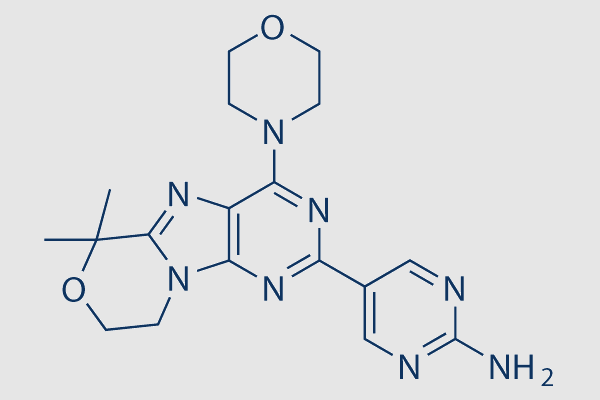
[CAS NO. 1382979-44-3] Paxalisib (GDC-0084)
Please click "REQUEST A QUOTE" button if you need other sizes or custom synthesis
request a quote
If there is no stock, or you need other sizes or custom synthesis, please:
PRODUCTS SPECIFICATIONS [1382979-44-3]
Store

Catalog
SLK-S8163
Brand
Selleck
CAS
1382979-44-3
DESCRIPTION [1382979-44-3]
Overview
| MDL | MFCD30187522 |
|---|---|
| Molecular Weight | 382.42 |
| Molecular Formula | C18H22N8O2 |
| SMILES | NC1=NC=C(C2=NC(N3CCOCC3)=C4N=C(C(C)(C)OCC5)N5C4=N2)C=N1 |
For research use only.
Storage
3 years,-20°C,powder
1 years,-80°C,in solvent
1 years,-80°C,in solvent
Shipping
Room temperature shipping(Stability testing shows this product can be shipped without any cooling measures.)
Preparing Stock Solutions
| 1 mg | 5 mg | 10 mg | |
| 1 mM | 2.6149 mL | 13.0746 mL | 26.1493 mL |
| 5 mM | 0.5230 mL | 2.6149 mL | 5.2299 mL |
| 10 mM | 0.2615 mL | 1.3075 mL | 2.6149 mL |
| 50 mM | - | - | - |
Description
Paxalisib (GDC-0084, RG7666) is a brain penetrant inhibitor of and with Kiapp values of 2 nM, 46 nM, 3 nM, 10 nM and 70 nM for PI3Kα, PI3Kβ, PI3Kδ, PI3Kγ and mTOR.
Targets
In vitro
GDC-0084 has excellent human metabolic stability in microsomal and hepatocyte incubations and demonstrated inhibition of pAKT, a key signal within the PI3K pathway, in normal brain tissue. GDC-0084 is shown to inhibit the proliferation of several glioma cells in vitro with IC50 ranging from 0.3 to 1.1 μM. GDC-0084 binding to plasma proteins is low, with a free fraction (%) of 29.5±2.7 (n=3) in CD-1 mouse plasma, when tested at 5 μM. Binding to brain tissues from CD-1 mice is higher, with a free fraction of 6.7% (±1; n=3).
In vivo
GDC-0084 markedly inhibits the PI3K pathway in mouse brain, causing up to 90% suppression of the pAkt signal. GDC-0084 achieves significant tumor growth inhibition of 70% and 40% against the U87 and GS2 orthotopic models, respectively. GDC-0084 distribution throughout the brain and intracranial tumors leads to potent inhibition of the PI3K pathway. It is being evaluated in patients, and exposures reached at tolerated doses are consistent with those associated with efficacious doses in mouse models.
References

Powered by Arctom Copyright © 2026 Arctom. All rights
reserved.