
[CAS NO. 704869-38-5] SUN11602
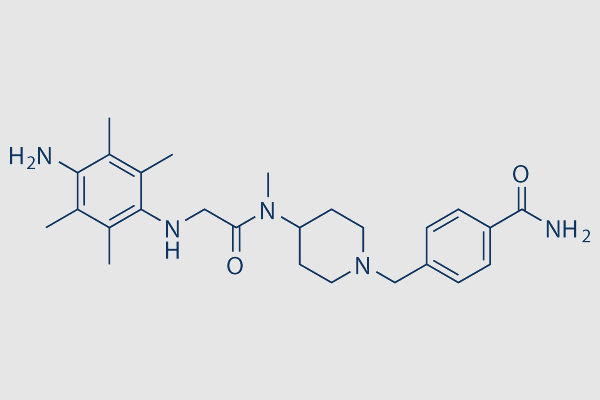
Please click "REQUEST A QUOTE" button if you need other sizes or custom synthesis
request a quote
If there is no stock, or you need other sizes or custom synthesis, please:
PRODUCTS SPECIFICATIONS [704869-38-5]
Store

Catalog
SLK-S8192
Brand
Selleck
CAS
704869-38-5
DESCRIPTION [704869-38-5]
Overview
| MDL | - |
|---|---|
| Molecular Weight | 451.60 |
| Molecular Formula | C26H37N5O2 |
| SMILES | - |
For research use only.
Storage
3 years,-20°C,powder
1 years,-80°C,in solvent
1 years,-80°C,in solvent
Shipping
Room temperature shipping(Stability testing shows this product can be shipped without any cooling measures.)
Description
SUN11602 is a small synthetic compound that mimics the neuroprotective activities of and activates key molecules in the FGF receptor-1-mitogen-activated protein kinase/extracellular signal-regulated kinase-1/2 kinase (FGFR-1-MEK/ERK) signaling pathway.
Targets
| bFGF [1] |
In vitro
Physiological actions of SUN11602 mimic several phenomena of the neuroprotection that is induced by bFGF. SUN11602 plays a pivotal role in allowing primary cultured neurons to survive in adverse environments of glutamate toxicity and activating intracellular key molecules that are involved in the neuroprotective mechanisms. These actions are quite similar to those of bFGF. Such neuroprotective mechanisms are specific and distinctive to SUN11602 and bFGF and differs clearly from those of the other growth factors that are investigated. But unlike bFGF, SUN11602 can either directly or indirectly trigger the phosphorylation of the cytosolic domain of the FGFR without binding to the extracellular domain of the FGFR-1. SUN11602 demonstrates no cell proliferative activity of somatic cells, unlike bFGF. SUN11602 significantly affects neuronal survival in adverse conditions through a FGFR1-mitogen-activated protein kinase/extracellular signal-regulated kinase-1/2 kinase (FGFR-1–MEK/ERK) signaling pathway.
In vivo
In WT mice, SUN11602 and bFGF increase the levels of newly synthesized Calb in cerebrocortical neurons and suppress the glutamate-induced rise in intracellular Ca2+. This Ca2+-capturing ability of Calb allows the neurons to survive severe toxic conditions of glutamate. In contrast, Calb levels remain unchanged in Calb-/- mice after exposure to SUN11602 or bFGF, and due to a loss of function of the gene, these neurons are no longer resistant to toxic conditions of glutamate. Neuroprotective activities of SUN11602 and FGF-2 are due to exogenously induced hyperexpression of CalB in hippocampal neurons. The pharmacokinetic properties of SUN11602 appear to hold promise in terms of bioavailability (>65%) after oral administration in rodents (rats and mice) and dogs (beagles).
References

Powered by Arctom Copyright © 2026 Arctom. All rights
reserved.