
[CAS NO. 1383982-64-6] Lanabecestat (AZD3293)
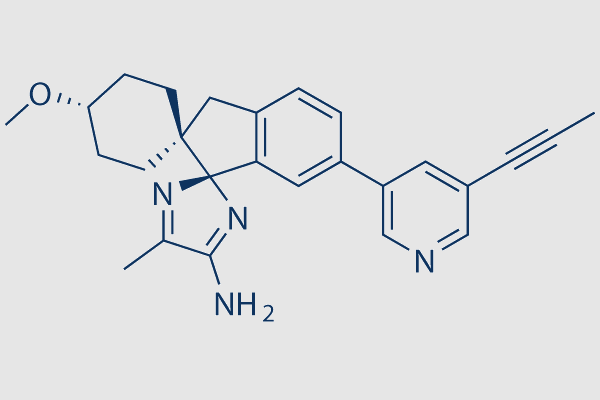
Please click "REQUEST A QUOTE" button if you need other sizes or custom synthesis
request a quote
If there is no stock, or you need other sizes or custom synthesis, please:
PRODUCTS SPECIFICATIONS [1383982-64-6]
Store

Catalog
SLK-S8193
Brand
Selleck
CAS
1383982-64-6
DESCRIPTION [1383982-64-6]
Overview
| MDL | - |
|---|---|
| Molecular Weight | 412.53 |
| Molecular Formula | C26H28N4O |
| SMILES | - |
For research use only.
Storage
3 years,-20°C,powder
1 years,-80°C,in solvent
1 years,-80°C,in solvent
Shipping
Room temperature shipping(Stability testing shows this product can be shipped without any cooling measures.)
Preparing Stock Solutions
| 1 mg | 5 mg | 10 mg | |
| 1 mM | 2.4241 mL | 12.1203 mL | 24.2407 mL |
| 5 mM | 0.4848 mL | 2.4241 mL | 4.8481 mL |
| 10 mM | 0.2424 mL | 1.2120 mL | 2.4241 mL |
| 50 mM | 0.0485 mL | 0.2424 mL | 0.4848 mL |
Description
Lanabecestat (AZD3293, LY3314814) is an oral inhibitor with an inhibitory constant Ki of 0.4 nM.
Targets
| BACE [1] (Cell-free assay) |
| 0.4 nM(Ki) |
In vitro
Lanabecestat(AZD3293, LY3314814)is a potent, highly permeable, orally active, blood-brain barrier (BBB) penetrating, BACE1 inhibitor with unique slow off-rate kinetics. When the potency of AZD3293 with respect to secretion of Aβ40 and sAβPPβ is studied in a range of cellular models, the compound displays pM potency in primary neuron cultures from mice and guinea pigs and in SH-SY5Y cells over-expressing AβPP (IC50 = 610 pM, 310 pM, and 80 pM, respectively). AZD3293 is also tested in a panel of more than 350 in vitro radioligand binding and enzyme activity assays, covering a diverse range of receptors, ion channels, transporters, kinases, and enzymes, up to a concentration of 10μM of AZD3293. A few significant responses are observed, but these had at least a 1,000-fold selectivity against BACE1, thus indicating specificity to BACE1. The off-rate of AZD3293 has an estimated t of approximately 9 h.
In vivo
In vivo in mice, guinea pigs, and dogs, AZD3293 displays significant dose- and time-dependent reductions in plasma, cerebrospinal fluid, and brain concentrations of Aβ40, Aβ42, and sAβPPβ. In the dog PK study, the bioavailability of AZD3293 is determined to be 80% (F = 0.8). The preclinical data strongly support the clinical development of AZD3293, and patients with AD are currently being recruited into a combined Phase 2/3 study to test the disease-modifying properties of AZD3293.

Powered by Arctom Copyright © 2026 Arctom. All rights
reserved.