
[CAS NO. 1346547-00-9] GSK583
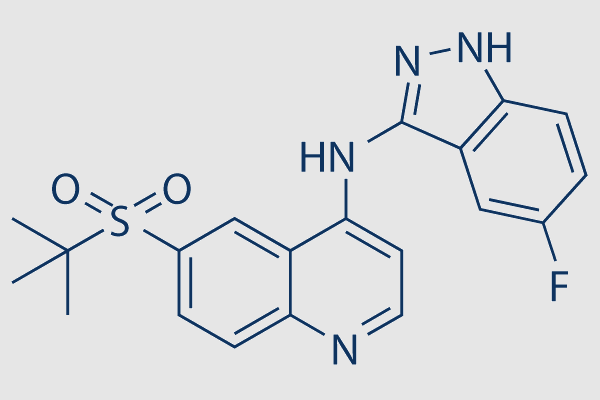
Please click "REQUEST A QUOTE" button if you need other sizes or custom synthesis
request a quote
If there is no stock, or you need other sizes or custom synthesis, please:
PRODUCTS SPECIFICATIONS [1346547-00-9]
Store

Catalog
SLK-S8261
Brand
Selleck
CAS
1346547-00-9
DESCRIPTION [1346547-00-9]
Overview
| MDL | MFCD30343846 |
|---|---|
| Molecular Weight | 398.45 |
| Molecular Formula | C20H19FN4O2S |
| SMILES | FC1=CC2=C(NN=C2NC3=CC=NC4=CC=C(S(=O)(C(C)(C)C)=O)C=C34)C=C1 |
For research use only.
Storage
3 years,-20°C,powder
1 years,-80°C,in solvent
1 years,-80°C,in solvent
Shipping
Room temperature shipping(Stability testing shows this product can be shipped without any cooling measures.)
Preparing Stock Solutions
| 1 mg | 5 mg | 10 mg | |
| 1 mM | 2.5097 mL | 12.5486 mL | 25.0973 mL |
| 5 mM | 0.5019 mL | 2.5097 mL | 5.0195 mL |
| 10 mM | 0.2510 mL | 1.2549 mL | 2.5097 mL |
| 50 mM | 0.0502 mL | 0.2510 mL | 0.5019 mL |
Description
GSK583 is a highly potent and selective inhibitor of with IC50 of 5 nM. GSK583 also inhibits both and production with IC50 of ~200 nM in explant cultures.
In vitro
GSK583 possesses comparable binding affinity for RIP3 kinase as demonstrated by an in-house FP binding assay configured similarly to the RIP2 FP assay (RIP2 FP IC50 = 5 nM; RIP3 FP IC50 = 16 nM). Despite this potent biochemical activity against RIP3 kinase, GSK583 shows little or no inhibition of RIP3-dependent necroptotic cell death in a cellular assay up to 10 μM concentration. GSK583 potently and dose dependently inhibits MDP-stimulated tumor necrosis factor-alpha (TNFα) production with an IC50 = 8 nM in primary human monocytes. Following treatment with GSK583 at 1 μM, little inhibition of pro-inflammatory signaling is observed upon activation of Toll-like receptors (TLR2, TLR4, TLR7) or cytokine receptors (IL-1R, TNFR) but complete inhibition is observed upon activation of both NOD1 and NOD2 receptors, which signal in a RIP2-dependent manner. Although GSK583 has excellent kinase selectivity, it does inhibit both the hERG channel and Cyp3A4, which precludes it from further progression as a drug candidate.
In vivo
GSK583 has low clearance, moderate volumes of distribution, and moderate oral bioavailability in both rat and mouse. Eventhough GSK583 would not produce a human phamacodynamic response within an acceptable dose range which precludes this molecule from further development as a drug candidate, the oral PK in rat and mouse provides sufficient systemic exposure for use as a preclinical in vivo tool molecule in an acute inflammation challenge model.

Powered by Arctom Copyright © 2026 Arctom. All rights
reserved.