
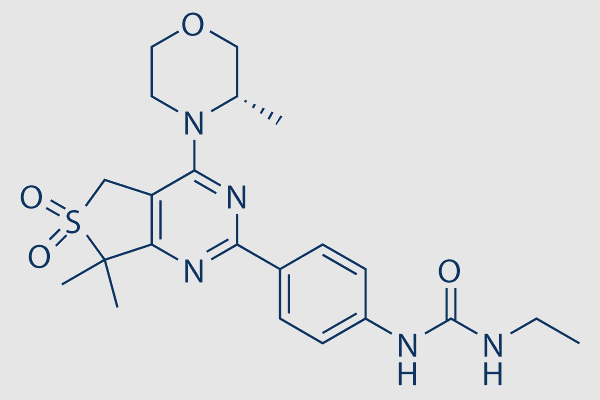
[CAS NO. 1429639-50-8] CZ415
Please click "REQUEST A QUOTE" button if you need other sizes or custom synthesis
request a quote
If there is no stock, or you need other sizes or custom synthesis, please:
PRODUCTS SPECIFICATIONS [1429639-50-8]
Store

Catalog
SLK-S8298
Brand
Selleck
CAS
1429639-50-8
DESCRIPTION [1429639-50-8]
Overview
| MDL | - |
|---|---|
| Molecular Weight | 459.56 |
| Molecular Formula | C22H29N5O4S |
| SMILES | O=C(NCC)NC1=CC=C(C2=NC(N3[C@@H](C)COCC3)=C4C(C(C)(C)S(C4)(=O)=O)=N2)C=C1 |
For research use only.
Storage
3 years,-20°C,powder
1 years,-80°C,in solvent
1 years,-80°C,in solvent
Shipping
Room temperature shipping(Stability testing shows this product can be shipped without any cooling measures.)
Preparing Stock Solutions
| 1 mg | 5 mg | 10 mg | |
| 1 mM | 2.1760 mL | 10.8800 mL | 21.7599 mL |
| 5 mM | 0.4352 mL | 2.1760 mL | 4.3520 mL |
| 10 mM | 0.2176 mL | 1.0880 mL | 2.1760 mL |
| 50 mM | 0.0435 mL | 0.2176 mL | 0.4352 mL |
Description
CZ415, a potent ATP-competitive inhibitor with very good cell permeability.
Targets
| mTOR [1] (Cell-free assay) |
| 8.07(pIC50) |
In vitro
CZ415 shows no genotoxic potential and has very good cell permeability. Treatment of CZ415 leads to inhibition of phosphorylation for downstream targets of mTORC1 and mTORC2(IC50=14.5 nM for pS6RP and IC50=14.8 nM for pAKT). The immunosuppressive effect of CZ415 is measured by detecting secreted IFNγ after 18 h in stimulated human whole blood, and the resulting IC50 was 226 nM. CZ415 shows no genotoxic potential. It is neither mutagenic in a bacterial mutation assay (Ames test) nor does it show genotoxicity in the mouse lymphoma assay (MLA), in either the presence or absence of rat-liver S9 mix.
In vivo
In vivo studies show that CZ415 has moderate clearance and good oral bioavailability. In an anti-CD3 mouse model CZ415 efficiently inhibits mTOR downstream signaling and, in a CIA mouse model, shows significant antiinflammatory effects. With its extraordinary selectivity, drug-like properties and proven efficacy in vivo, CZ415 represents an ideal molecule for the pharmacological investigation of mTOR pathophysiological role in vivo.

Powered by Arctom Copyright © 2026 Arctom. All rights
reserved.