
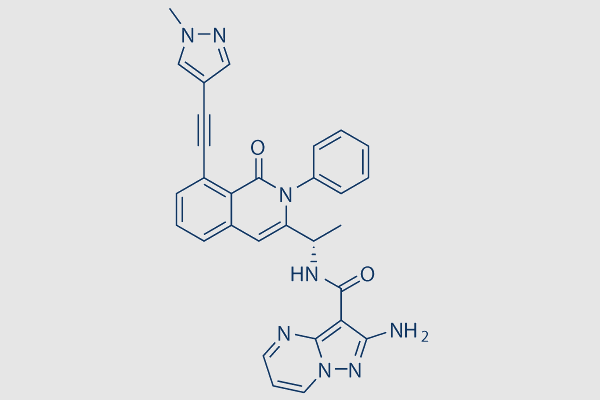
[CAS NO. 1693758-51-8] Eganelisib (IPI-549)
Please click "REQUEST A QUOTE" button if you need other sizes or custom synthesis
request a quote
If there is no stock, or you need other sizes or custom synthesis, please:
PRODUCTS SPECIFICATIONS [1693758-51-8]
Store

Catalog
SLK-S8330
Brand
Selleck
CAS
1693758-51-8
DESCRIPTION [1693758-51-8]
Overview
| MDL | MFCD30533720 |
|---|---|
| Molecular Weight | 528.56 |
| Molecular Formula | C30H24N8O2 |
| SMILES | O=C(C1=C2N=CC=CN2N=C1N)N[C@H](C3=CC4=C(C(N3C5=CC=CC=C5)=O)C(C#CC6=CN(C)N=C6)=CC=C4)C |
For research use only.
Storage
3 years,-20°C,powder
1 years,-80°C,in solvent
1 years,-80°C,in solvent
Shipping
Room temperature shipping(Stability testing shows this product can be shipped without any cooling measures.)
Preparing Stock Solutions
| 1 mg | 5 mg | 10 mg | |
| 1 mM | 1.8919 mL | 9.4597 mL | 18.9193 mL |
| 5 mM | 0.3784 mL | 1.8919 mL | 3.7839 mL |
| 10 mM | 0.1892 mL | 0.9460 mL | 1.8919 mL |
| 50 mM | 0.0378 mL | 0.1892 mL | 0.3784 mL |
Description
Eganelisib (IPI-549) is a potent inhibitor of with >100-fold selectivity over other lipid and protein kinases. The biochemical for PI3K-γ is 16 nM.
Targets
| PI3Kγ [1] (Cell-free assay) |
| 16 nM |
In vitro
IPI-549 is found to be a remarkably tight binder to PI3K-γ with a Kd of 290 pM and >58-fold weaker affinity for other Class I PI3K isoforms. It does not significantly inhibit a panel of 468 mutant and nonmutant protein and lipid kinases (including Class II PI3K isoforms) at 1 μM. In PI3K-α, -β, -γ, and -δ dependent cellular phospho-AKT assays, IPI-549 demonstrates excellent PI3K-γ potency (IC50 = 1.2 nM) and selectivity against other Class I PI3K isoforms (>146-fold). Furthermore, IPI-549 dose dependently inhibits PI3K-γ-dependent bone marrow-derived macrophage (BMDM) migration in vitro. IPI-549 is also found to be selective against a panel of 80 GPCRs, ion channels, and transporters at 10 μM. In vitro, IPI-549 shows moderate to high cell permeability across Caco-2 cell monolayers, is slowly metabolized in cultured hepatocytes (t1/2 > 360 min), and demonstrates IC50s greater than 20 μM for the CYP isoforms tested (1A2, 2B6, 2C8, 2C9, 2C19, 2D6, 3A4).
In vivo
In vivo (mice, rats, dog, and monkeys), IPI-549 has excellent oral bioavailability, low clearance, and distributes into tissues with a mean volume of distribution of 1.2 L/kg. It has a favorable pharmacokinetic profile to allow potent and selective inhibition of PI3K-γ in vivo. IPI-549 can significantly reduce neutrophil migration in a dose-dependent manner in mouse model when administered orally at all of the tested doses. In addition, IPI-54 has been shown to inhibit tumor growth in murine syngeneic models through alteration of immune cells in the tumor microenvironment.

Powered by Arctom Copyright © 2026 Arctom. All rights
reserved.