
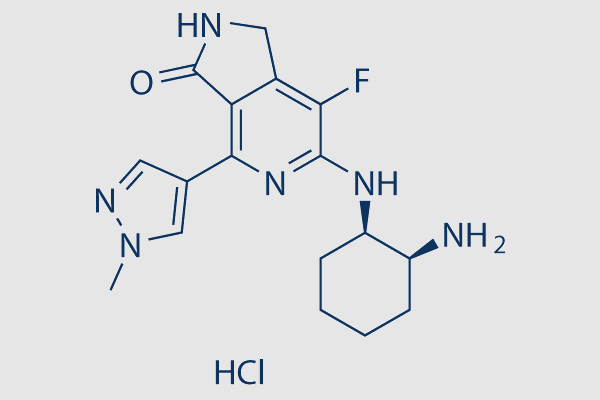
[CAS NO. 1952251-28-3] TAK-659
Please click "REQUEST A QUOTE" button if you need other sizes or custom synthesis
request a quote
If there is no stock, or you need other sizes or custom synthesis, please:
PRODUCTS SPECIFICATIONS [1952251-28-3]
Store

Catalog
SLK-S8442
Brand
Selleck
CAS
1952251-28-3
DESCRIPTION [1952251-28-3]
Overview
| MDL | - |
|---|---|
| Molecular Weight | 380.85 |
| Molecular Formula | C17H21FN6 .HCl |
| SMILES | O=C1NCC2=C1C(C3=CN(C)N=C3)=NC(N[C@H]4[C@@H](N)CCCC4)=C2F.[H]Cl |
For research use only.
Storage
3 years,-20°C,powder
1 years,-80°C,in solvent
1 years,-80°C,in solvent
Shipping
Room temperature shipping(Stability testing shows this product can be shipped without any cooling measures.)
Preparing Stock Solutions
| 1 mg | 5 mg | 10 mg | |
| 1 mM | 2.6257 mL | 13.1285 mL | 26.2571 mL |
| 5 mM | 0.5251 mL | 2.6257 mL | 5.2514 mL |
| 10 mM | - | - | - |
| 50 mM | - | - | - |
Description
TAK-659 is a potent and selective inhibitor of with an value of 3.2 nM. It is selective against most other kinases, but potent toward both and .
Targets
In vitro
In a cell proliferation assay, TAK-659 shows inhibition toward a SYK-dependent cell line (OCI-LY10). the sensitivity to TAK-659 is associated with mutations impacting SYK activity in B cell lymphomas, whereas TAK-659 is not cytotoxic for adherent primary or solid tumor cell lines. In cell viability assays, TAK-659 is shown to be sensitive toward FLT3-ITD dependent cell lines, MV4-11 and MOLM-13 while the WT FLT3 RS4-11 (ALL cell line) and RA1 (Burkitt's Lymphoma cell line) are not sensitive toward TAK-659. In cultured human tumor cells, TAK-659 potently inhibits the growth of hematopoietic-derived cell lines, with a concentration producing half-maximal response (EC50) ranging from 11 to 775 nM in sensitive cell systems (eg, diffuse large B-cell lymphoma, and AML). In a broad kinase panel, TAK-659 demonstrates a more than 50-fold selectivity for SYK and FLT-3 over 290 other protein kinases. Treatment with TAK-659 inhibits Syk activation and BCR signaling in co-cultured primary CLL cells and Burkitt's lymphoma cells. In primary CLL cells in suspension culture, TAK-659 treatment results in a dose-dependent reduction in the phosphorylation of SykTyr525, Btk, NFκB, ERK1/2 and STAT3 after BCR stimulation. Inhibition of Syk by TAK-659 induces apoptosis of CLL cells and abrogates BCR and co-culture-derived survival signals. TAK-659 inhibits chemotaxis toward BMSC, CXCL12 and CXCL13 in primary CLL cells, and abrogates microenvironment-induced chemoresistance. TAK-659 does not inhibit TCR signaling and molecular features of T cell activation in primary T cells from patients with CLL.
In vivo
TAK-659 blocks anti-IgD (immune-globulin D antibody) stimulated CD86 expression in mouse peripheral B cells in vivo. In the FLT3-dependent MV4-11 xenograft model, TAK-659 shows tumor regression at 60 mg/kg daily after 20 days of dosing. Preliminary plasma and urine PK data show that TAK-659 was absorbed quickly (median Tmax 2-3 hrs), with moderate variability in steady-state exposures (40-50% CV for DN-AUCtau), mean peak/trough ratio of 3.2–4.2, and mean accumulation of 2.1- to 2.6-fold after 15 d QD dosing. Renal clearance (CLr) of unchanged drug accounts for 30–34% of apparent oral clearance, suggesting a CLr contribution of ≥30–34% to TAK-659 systemic clearance. Oral TAK-659 has an acceptable PK and safety profile in pts with solid tumors or lymphoma, supporting continuous oral QD dosing.
References

Powered by Arctom Copyright © 2026 Arctom. All rights
reserved.