
[CAS NO. 1316215-12-9] Citarinostat (ACY-241)
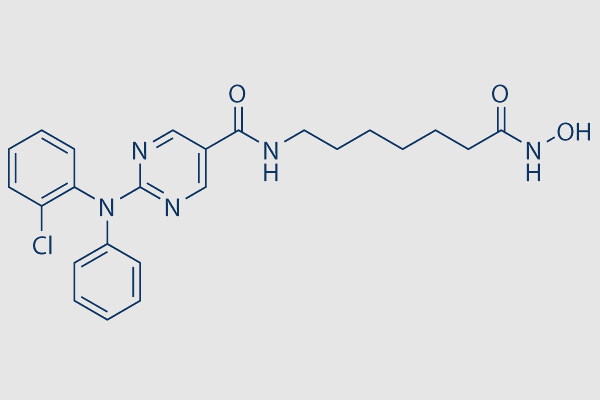
Please click "REQUEST A QUOTE" button if you need other sizes or custom synthesis
request a quote
If there is no stock, or you need other sizes or custom synthesis, please:
PRODUCTS SPECIFICATIONS [1316215-12-9]
Store

Catalog
SLK-S8464
Brand
Selleck
CAS
1316215-12-9
DESCRIPTION [1316215-12-9]
Overview
| MDL | MFCD28023593 |
|---|---|
| Molecular Weight | 467.95 |
| Molecular Formula | C24H26ClN5O3 |
| SMILES | O=C(C1=CN=C(N(C2=CC=CC=C2Cl)C3=CC=CC=C3)N=C1)NCCCCCCC(NO)=O |
For research use only.
Storage
3 years,-20°C,powder
1 years,-80°C,in solvent
1 years,-80°C,in solvent
Shipping
Room temperature shipping(Stability testing shows this product can be shipped without any cooling measures.)
Preparing Stock Solutions
| 1 mg | 5 mg | 10 mg | |
| 1 mM | 2.1370 mL | 10.6849 mL | 21.3698 mL |
| 5 mM | 0.4274 mL | 2.1370 mL | 4.2740 mL |
| 10 mM | 0.2137 mL | 1.0685 mL | 2.1370 mL |
| 50 mM | 0.0427 mL | 0.2137 mL | 0.4274 mL |
Description
Citarinostat (ACY-241, HDAC-IN-2) is an orally available selective inhibitor with IC50 of 2.6 nM and 46 nM for HDAC6 and HDAC3, respectively. It has 13 to 18-fold selectivity towards HDAC6 in comparison to HDAC1-3.
Targets
In vitro
In cell lines from multiple solid tumor lineages, combination treatment with ACY-241 and paclitaxel enhances inhibition of proliferation and increases cell death relative to either single agent alone. Combination treatment with ACY-241 and paclitaxel also results in more frequent occurrence of mitotic cells with abnormal multipolar spindles and aberrant mitoses, and is associated with increased frequency of abnormal multipolar mitotic spindle formation, induction of aneuploidy, and increased cell death. In A2780 ovarian cancer cells, 24 hour treatment with 300 nM ACY-241 results in increased hyperacetylation of α-tubulin, consistent with inhibition of the tubulin deacetylase HDAC6. Low exposures of ACY-241 result in selective inhibition of HDAC6, while higher exposures lead to inhibition of Class I HDAC isozymes.
In vivo
ACY-241 has a favourable safety profile than non-selective pan-HDAC inhibitors. It has the potential for a substantially reduced side effect profile versus current nonselective HDAC inhibitor drug candidates due to reduced potency against Class I HDACs while retaining the potential for anticancer effectiveness.

Powered by Arctom Copyright © 2026 Arctom. All rights
reserved.