
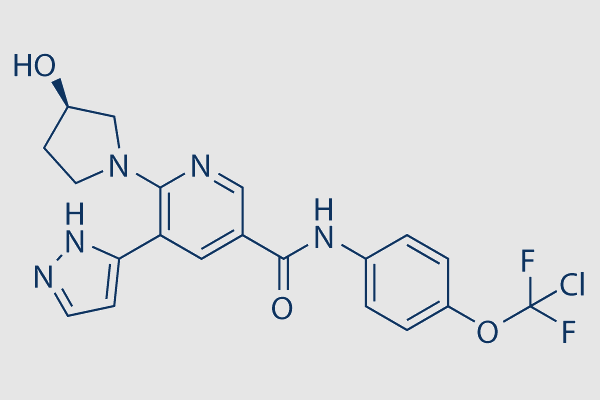
[CAS NO. 1492952-76-7] Asciminib (ABL001)
Please click "REQUEST A QUOTE" button if you need other sizes or custom synthesis
request a quote
If there is no stock, or you need other sizes or custom synthesis, please:
PRODUCTS SPECIFICATIONS [1492952-76-7]
Store

Catalog
SLK-S8555
Brand
Selleck
CAS
1492952-76-7
DESCRIPTION [1492952-76-7]
Overview
| MDL | MFCD31560488 |
|---|---|
| Molecular Weight | 449.84 |
| Molecular Formula | C20H18ClF2N5O3 |
| SMILES | O=C(NC1=CC=C(OC(F)(Cl)F)C=C1)C2=CN=C(N3C[C@H](O)CC3)C(C4=NNC=C4)=C2 |
For research use only.
Storage
3 years,-20°C,powder
1 years,-80°C,in solvent
1 years,-80°C,in solvent
Shipping
Room temperature shipping(Stability testing shows this product can be shipped without any cooling measures.)
Preparing Stock Solutions
| 1 mg | 5 mg | 10 mg | |
| 1 mM | 2.2230 mL | 11.1151 mL | 22.2301 mL |
| 5 mM | 0.4446 mL | 2.2230 mL | 4.4460 mL |
| 10 mM | 0.2223 mL | 1.1115 mL | 2.2230 mL |
| 50 mM | 0.0445 mL | 0.2223 mL | 0.4446 mL |
Description
Asciminib (ABL001) is a potent and selective allosteric inhibitor with dissociation constant (Kd) of 0.5-0.8 nM and selectivity to the myristoyl pocket of ABL1.
Targets
| Abl1 [1] (Cell-free assay) |
| 0.45 nM |
In vitro
ABL001 is a potent, selective BCR-ABL inhibitor that maintains activity across most mutations, including T315I, with a distinct, allosteric mechanism of action. ABL001 binds at a regulatory site typically occupied by a myristoyl group in wild-type ABL and inhibits ABL kinase activity through a mechanism distinct from catalytic site inhibitors. It binds to a pocket on the BCR-ABL kinase domain that is normally occupied by the myristoylated N-terminus of ABL1. Upon fusion with BCR, this myristoylated N-terminus that serves to autoregulate ABL1 activity is lost. ABL001 functionally mimics the role of the myristoylated N-terminus by occupying its vacant binding site and restores the negative regulation of the kinase activity. ABL001 selectively inhibits the growth of chronic myelogenous leukemia (CML) and Ph+ ALL cells with potencies ranging from 1-10 nM range while BCR-ABL-negative cell lines remained unaffected at concentrations 1000-fold higher. NMR and biophysical studies confirm that ABL001 binds potently (dissociation constant (Kd) = 0.5-0.8 nM) and selectively to the myristoyl pocket of ABL1 and induces the inactive C-terminal helix conformation. ABL001 lacks activity against more than 60 kinases, including SRC and is similarly inactive against G-protein-coupled receptors, ion channels, nuclear receptors and transporters. Thus, ABL001 has high selectivity.
In vivo
In the KCL-22 mouse xenograft model, ABL001 displays potent anti-tumor activity with complete tumor regression observed and a clear dose-dependent correlation with pSTAT5 inhibition. ABL001 has moderate oral absorption, volume of distribution and half-life across all species. It as a single agent induces clinical anti-tumour activity and is well tolerated to date in a heavily pre-treated subgroup of patients with chronic myelogenous leukemia. As for the pharmacokinetics, pharmacodynamics and efficacy of ABL001, The CL (clearance) are 12, 16 and 6 mL/min/kg in mice, rats and dogs after a sigle iv dose of 1mg/kg, 2mg/kg and 1mg/kg, respectively. In mouse and dog, the T are 1.1 and 3.7 h after a single i.v. dose at 1 mg/kg. In Rat, theT is 2.7 h after a single i.v. dose at 2 mg/kg. The oral bioavailability of ABL001 in mouse and rat are 35% and 27% respectively when dosed at 30 mg/kg p.o. While in dogs the oral BA of ABL001 is 111% (15 mg/kg, p.o).
References

Powered by Arctom Copyright © 2026 Arctom. All rights
reserved.