
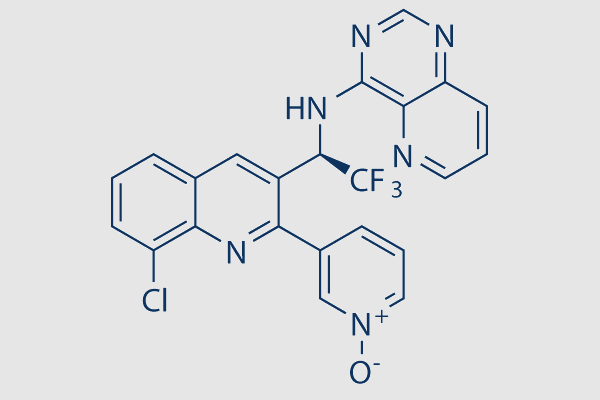
[CAS NO. 1362850-20-1] Seletalisib (UCB-5857)
Please click "REQUEST A QUOTE" button if you need other sizes or custom synthesis
request a quote
If there is no stock, or you need other sizes or custom synthesis, please:
PRODUCTS SPECIFICATIONS [1362850-20-1]
Store

Catalog
SLK-S8560
Brand
Selleck
CAS
1362850-20-1
DESCRIPTION [1362850-20-1]
Overview
| MDL | MFCD28963973 |
|---|---|
| Molecular Weight | 482.85 |
| Molecular Formula | C23H14ClF3N6O |
| SMILES | FC(F)(F)[C@@H](C1=CC2=CC=CC(Cl)=C2N=C1C3=C[N+]([O-])=CC=C3)NC4=C5C(C=CC=N5)=NC=N4 |
For research use only.
Storage
3 years,-20°C,powder
1 years,-80°C,in solvent
1 years,-80°C,in solvent
Shipping
Room temperature shipping(Stability testing shows this product can be shipped without any cooling measures.)
Description
Seletalisib (UCB-5857) is a novel small-molecule inhibitor of with an IC50 value of 12 nM and shows significant selectivity to PI3Kδ with respect to the other class I PI3K isoforms (between 24- and 303-fold).
In vitro
Seletalisib is a potent, ATP-competitive, and selective PI3Kδ inhibitor able to block protein kinase B (AKT) phosphorylation following activation of the B-cell receptor in a B-cell line. Moreover, seletalisib inhibited N-formyl peptide-stimulated but not phorbol myristate acetate–stimulated superoxide release from human neutrophils, consistent with a PI3Kδ-specific activity. Findings from cellular assays of adaptive immunity demonstrated that seletalisib blocks human T-cell production of several cytokines from activated T-cells. Additionally, seletalisib inhibited B-cell proliferation and cytokine release. In human whole blood assays, seletalisib inhibited CD69 expression upon B-cell activation and anti-IgE-mediated basophil degranulation. From 239 kinases screened, seletalisib at a concentration of 10 μM showed no inhibitory activity greater than 47% (MAP4K4) against non-PI3K kinase enzymes. Against nonkinase enzymes, seletalisib showed weak activities against phosphodiesterase (PDE)3A, PDE2A1, and PDE4D2, with inhibition varying between 32 and 74% at 10 μM. When screened at a concentration of 10 μM against 55 receptors and ion channels, the highest inhibitory activity of seletalisib observed was 20%. One receptor, neuropeptide Y receptor (Y1) showed 54% activation. In vitro receptor binding and enzyme assays across a broad range of target classes showed that seletalisib is selective for PI3Kδ. Seletalisib potently inhibited the phosphorylation of AKT following anti-IgM stimulation of the BCR on Ramos cells with an IC50 of 15 nM. When profiled in a wide range of primary cell assay systems, including fibroblasts, epithelial, endothelial and vascular smooth muscle cells, seletalisib showed significant activity only in those systems containing lymphocytes, demonstrating its functional selectivity towards PI3Kδ-expressing cells.
References

Powered by Arctom Copyright © 2026 Arctom. All rights
reserved.