
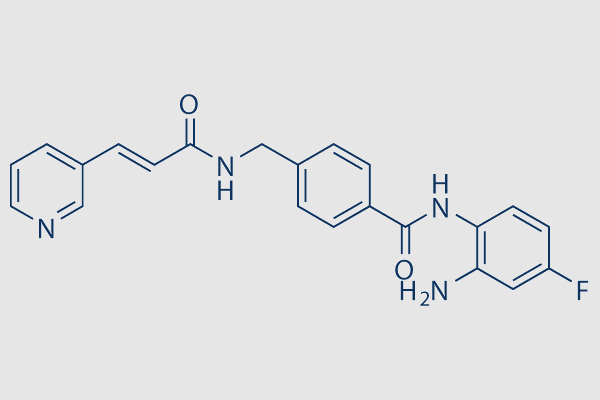
[CAS NO. 1616493-44-7] Tucidinostat (Chidamide)
Please click "REQUEST A QUOTE" button if you need other sizes or custom synthesis
request a quote
If there is no stock, or you need other sizes or custom synthesis, please:
PRODUCTS SPECIFICATIONS [1616493-44-7]
Store

Catalog
SLK-S8567
Brand
Selleck
CAS
1616493-44-7
DESCRIPTION [1616493-44-7]
Overview
| MDL | - |
|---|---|
| Molecular Weight | 390.41 |
| Molecular Formula | C22H19FN4O2 |
| SMILES | C(NC1=C(N)C=C(F)C=C1)(=O)C2=CC=C(CNC(/C=C/C=3C=CC=NC3)=O)C=C2 |
For research use only.
Storage
3 years,-20°C,powder
1 years,-80°C,in solvent
1 years,-80°C,in solvent
Shipping
Room temperature shipping(Stability testing shows this product can be shipped without any cooling measures.)
Preparing Stock Solutions
| 1 mg | 5 mg | 10 mg | |
| 1 mM | 2.5614 mL | 12.8070 mL | 25.6141 mL |
| 5 mM | 0.5123 mL | 2.5614 mL | 5.1228 mL |
| 10 mM | 0.2561 mL | 1.2807 mL | 2.5614 mL |
| 50 mM | 0.0512 mL | 0.2561 mL | 0.5123 mL |
Description
Tucidinostat (Chidamide, HBI-8000, CS-055) is a low nanomolar inhibitor of , the HDAC isotypes well documented to be associated with the malignant phenotype with IC50 values of 95, 160, 67, 78 nM for HDAC1, 2, 3, 10 respectively.
Targets
In vitro
Chidamide inhibits class I HDACs 1-3, as well as class IIb HDAC10, at low nanomolar concentrations. Chidamide significantly induces histone H3 acetylation in both HeLa human cervical adenocarcinoma cells and human PBMC. Cell growth inhibition studies performed with 18 human-derived tumor cell lines demonstrate that chidamide and MS-275 similarly inhibit the in vitro growth of most, but not all, tumor cells in the low micromolar concentration range. However, chidamide, and to a lesser extent MS-275, is significantly less toxic to normal cells from human fetal kidney (CCC-HEK) and liver (CCC-HEL), indicating a differential cytotoxic response of normal cells versus cancerous cells to chidamide.
In vivo
In HCT-8 colorectal carcinoma mice xenografts, Chidamide shows in vivo antitumor activity. Chidamide in the dose range of 12.5-50 mg/kg dose-dependently reduces tumor size and tumor weight, and the dose of 50 mg/kg produces similar or greater efficacy compared with the control drugs 5-fluorouracil(5-FU, 20 mg/kg) and MS-275 (25 mg/kg, which was reported as the maximum tolerated dose in xenograft models). However, chidamide is well-tolerated at the above doses in the tumor-bearing animals, whereas the control drugs cause significant weight loss.
Synonyms
Benzamide, N-(2-amino-4-fluorophenyl)-4-[[[(2E)-1-oxo-3-(3-pyridinyl)-2-propen-1-yl]amino]methyl]-
N-(2-Amino-4-fluorophenyl)-4-[[[(2E)-1-oxo-3-(3-pyridinyl)-2-propen-1-yl]amino]methyl]benzamide
Tucidinostat
HBI 8000
Epidaza
Chidamide
CS 055
(4-(2-Amino-4-fluorophenyl)carbamoylphenyl)methyl (E)-3-(3-pyridyl)acrylamide

Powered by Arctom Copyright © 2026 Arctom. All rights
reserved.