
[CAS NO. 1174428-47-7] SF2523
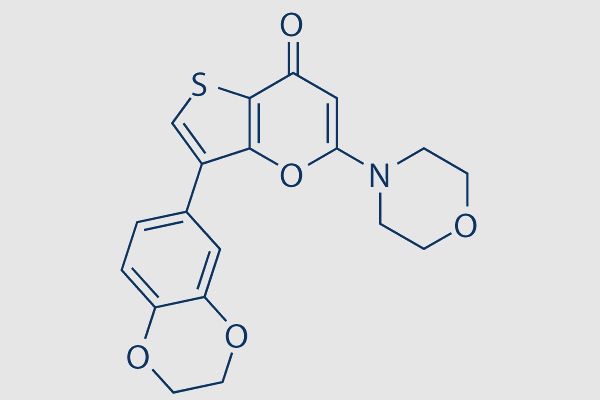
Please click "REQUEST A QUOTE" button if you need other sizes or custom synthesis
request a quote
If there is no stock, or you need other sizes or custom synthesis, please:
PRODUCTS SPECIFICATIONS [1174428-47-7]
Store

Catalog
SLK-S8589
Brand
Selleck
CAS
1174428-47-7
DESCRIPTION [1174428-47-7]
Overview
| MDL | MFCD31382129 |
|---|---|
| Molecular Weight | 371.41 |
| Molecular Formula | C19H17NO5S |
| SMILES | O=C1C2=C(C(C3=CC=C(OCCO4)C4=C3)=CS2)OC(N5CCOCC5)=C1 |
For research use only.
Storage
3 years,-20°C,powder
1 years,-80°C,in solvent
1 years,-80°C,in solvent
Shipping
Room temperature shipping(Stability testing shows this product can be shipped without any cooling measures.)
Preparing Stock Solutions
| 1 mg | 5 mg | 10 mg | |
| 1 mM | 2.6924 mL | 13.4622 mL | 26.9244 mL |
| 5 mM | 0.5385 mL | 2.6924 mL | 5.3849 mL |
| 10 mM | 0.2692 mL | 1.3462 mL | 2.6924 mL |
| 50 mM | 0.0538 mL | 0.2692 mL | 0.5385 mL |
Description
SF2523 is a highly selective and potent inhibitor of with IC50 values of 34 nM, 158 nM, 9 nM, 241 nM and 280 nM for , respectively.
Targets
In vitro
SF2523 blocks BRD4 binding to MYCN promoter PS1/PS2. It blocks M1-M2 transition and decreases levels of p-AKT, N-MYC in several neuroblastoma cell lines. SF2523 treatment decreases protein levels of MYCN and Cyclin D1, the MYCN target, and inhibits AKT activation by blocking phosphorylation of AKT at Ser473. SF2523 interacts robustly with the full-length BRD4 (Kd = 140 nM) and exhibits comparable affinity to the BRD4 first BD (BD1) (Kd =150 nM), however it binds more weakly to the second BD (BD2) of BRD4 (Kd = 710 nM). Comparison of binding affinities of SF2523 for BDs of other proteins reveals that it binds equally well to BDs of BRD4, BRD2, and BRD3; shows moderate binding to BDs of CECR2 and BRDT; but associates much weaker with other BDs.
In vivo
SF2523 blocks spontaneous metastasis and tumor growth. SF2523 has demonstrated animal efficacy results without toxicity in the following 4 animal models: orthotopic pancreatic model, multiple myeloma model, renal cell carcinoma model, neuroblastoma xenograft model. SF2523 targets PI3K-driven and BRD4-driven oncogenic pathways in vivo. SF2523 is less toxic to the host organism in vivo than a combination of an equipotent PI3K inhibitor and BRD4 inhibitor.
References

Powered by Arctom Copyright © 2026 Arctom. All rights
reserved.