
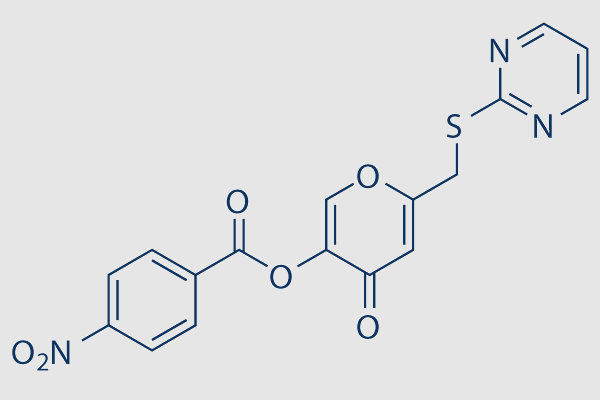
[CAS NO. 877636-42-5] ML221
Please click "REQUEST A QUOTE" button if you need other sizes or custom synthesis
request a quote
If there is no stock, or you need other sizes or custom synthesis, please:
PRODUCTS SPECIFICATIONS [877636-42-5]
Store

Catalog
SLK-S8695
Brand
Selleck
CAS
877636-42-5
DESCRIPTION [877636-42-5]
Overview
| MDL | MFCD06407006 |
|---|---|
| Molecular Weight | 385.35 |
| Molecular Formula | C17H11N3O6S |
| SMILES | O=C1C=C(CSC2=NC=CC=N2)OC=C1OC(C3=CC=C([N+]([O-])=O)C=C3)=O |
For research use only.
Storage
3 years,-20°C,powder
1 years,-80°C,in solvent
1 years,-80°C,in solvent
Shipping
Room temperature shipping(Stability testing shows this product can be shipped without any cooling measures.)
Preparing Stock Solutions
| 1 mg | 5 mg | 10 mg | |
| 1 mM | 2.5950 mL | 12.9752 mL | 25.9504 mL |
| 5 mM | 0.5190 mL | 2.5950 mL | 5.1901 mL |
| 10 mM | 0.2595 mL | 1.2975 mL | 2.5950 mL |
| 50 mM | - | - | - |
Description
ML221 is a potent apelin receptor (APJ) functional antagonist in cell-based assays that is >37-fold selective over the closely related angiotensin II type 1 (AT1) receptor. The IC50 values of ML221 are 0.70 and 1.75 μM in a cAMP assay and β-arrestin assay, respectively.
Targets
| apelin receptor [1] (β-arrestin assay) |
| 1.75 μM |
In vitro
In a PAMPA permeability assay, ML221 exhibits moderate permeability. ML221 displays moderate plasma and poor microsomal stability, as it is rapidly metabolized in both human and mouse liver homogenates (4.2% and 4.9% remaining at 60 min). It shows no toxicity (>50 μM) toward human hepatocytes. ML221 displays limited cross reactivity against a range of GPCRs. ML221 inhibits endothelial cell proliferation by blocking apelin-APJ signaling without affecting the expression of VEGF and VEGFR2.
In vivo
Intraperitoneal administration of ML221 inhibits pathological angiogenesis but enhances the recovery of normal vessels into the ischemic regions in the retina of the OIR model mice. A single application of ML221 alleviates mechanical allodynia and heat hyperalgesia 7 days following chronic constriction injury (CCI), in a dose‑dependent manner. Intraspinal delivery of ML221, at the onset of and in fully‑established neuropathic pain, persistently attenuates CCI‑induced pain hypersensitivity, indicating that the apelin‑APJ system is involved in initiating and maintaining pain. Intrathecal ML221 downregulates phosphorylated extracellular signal‑related kinase (ERK) in the rat spinal cord dorsal horn, suggesting that the effect of apelin on neuropathic pain may be mediated via ERK signaling.

Powered by Arctom Copyright © 2026 Arctom. All rights
reserved.