
[CAS NO. 1557267-42-1] Avitinib (AC0010)
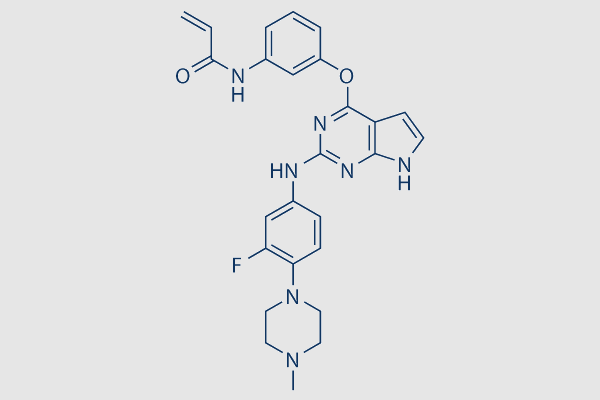
Please click "REQUEST A QUOTE" button if you need other sizes or custom synthesis
request a quote
If there is no stock, or you need other sizes or custom synthesis, please:
PRODUCTS SPECIFICATIONS [1557267-42-1]
Store

Catalog
SLK-S8741
Brand
Selleck
CAS
1557267-42-1
DESCRIPTION [1557267-42-1]
Overview
| MDL | - |
|---|---|
| Molecular Weight | 487.53 |
| Molecular Formula | C26H26FN7O2 |
| SMILES | C=CC(NC1=CC=CC(OC2=C3C(NC=C3)=NC(NC4=CC=C(N5CCN(C)CC5)C(F)=C4)=N2)=C1)=O |
For research use only.
Storage
3 years,-20°C,powder
1 years,-80°C,in solvent
1 years,-80°C,in solvent
Shipping
Room temperature shipping(Stability testing shows this product can be shipped without any cooling measures.)
Preparing Stock Solutions
| 1 mg | 5 mg | 10 mg | |
| 1 mM | 2.0512 mL | 10.2558 mL | 20.5116 mL |
| 5 mM | 0.4102 mL | 2.0512 mL | 4.1023 mL |
| 10 mM | 0.2051 mL | 1.0256 mL | 2.0512 mL |
| 50 mM | 0.0410 mL | 0.2051 mL | 0.4102 mL |
Description
Avitinib (AC0010) is a pyrrolopyrimidine-based irreversible inhibitor that is mutation-selective with IC50 value of 0.18 nM against EGFR L858R/T790M double mutations, nearly 43-fold greater potency over wild-type EGFR (IC50 value, 7.68 nM). It has comparable anti-tumor activity and tolerated toxicity.
Targets
In vitro
AC0010 selectively inhibits EGFR active and T790M mutations with up to 298-fold increase in potency compared to wild-type EGFR. AC0010 selectively inhibited mutant EGFR phosphorylation with IC50 values of 7.3 nM and 2.8 nM in NCI-H1975 and NIH/3T3_TC32T8 cells, about 115- and 298-fold more sensitive than that of the inhibition of wild type EGFR in A431. Immunoblotting analysis confirmed that AC0010 potently inhibited EGFR-Tyr1068 phosphorylation in NCI-H1975 cells, and the selectivity ratio is at 65-fold for NCI-H1975 cells versus A431 cells. In addition to inhibition of EGFR-Tyr1068 phosphorylation, AC0010 inhibited phosphorylation of the downstream targets Akt and ERK1/2, two important kinases involved in cancer cell proliferation and survival, in NCI-H1975 and HCC827 cells. The selectivity of AC0010 was also assessed by testing its activity against a panel of 349 kinases. At a concentration of 1 μM, AC0010 exhibited greater than 80% inhibition in 33 out of 349 unique kinase assays (9.5%). Kinase targets with greater than 80% inhibition include JAK3, BTK and 5 TEC family members. However, at the cellular level, the kinase inhibitory potency is much less than with the enzymatic assay. Much weaker inhibition was seen in BTK and JAK3 cellular assays with IC50 values of 59 nM and 360 nM. When tested against a selected panel of 55 key molecular targets including receptors, ion channels and transporters, AC0010 (1 μM) inhibits 5 out of 55 targets over 50% inhibition of radioligand binding, including Adenosine A3, L-type calcium (Cav1.2) channel, dopamine transporter, 5-HT2A and 5-HT2B. However, in cell-based functional assays, no inhibition was detected for above 5 targets, implying that the risk of off-target binding of AC0010 is minimal at pharmacologically relevant concentrations.
References

Powered by Arctom Copyright © 2026 Arctom. All rights
reserved.