3 Million+ Unique Research Compounds, Real-time Pricing & Availability
Sign in
to enjoy up to 20% OFF
or
Sign Up
Product Search
Structure Search
[email protected]
Chemistry
Organometallic Reagents
Organic Building Blocks
Catalysis Chemistry
Asymmetric Synthesis
Synthetic Reagents
Chemical Biology
Specialty Synthesis
Stains and Dyes
Heterocyclic Building Blocks
Inorganic reagents
Boronic acids/esters
Bioactive Molecules
Anti-infection
Apoptosis
Autophagy
Cell Cycle/DNA Damage
Cytoskeleton
Epigenetics
GPCR/G Protein
Immunology/Inflammation
JAK/STAT Signaling
MAPK/ERK Pathway
Membrane Transporter/Ion Channel
Metabolic Enzyme/Protease
Neuronal Signaling
NF-κB
PI3K/Akt/mTOR
PROTAC
Protein Tyrosine Kinase/RTK
Stem Cell/Wnt
TGF-beta/Smad
Vitamin D Related/Nuclear Receptor
Others
Methylation
Cytoskeletal Signaling
Screening Libraries
Focused and targeted libraries
Active Reference Sets
Diversity libraries
Preplated libraries
Inhibitors and Approved Drugs
Natural Products Series
Bioactive Compound Series
Diversity Compound Libraries
Fragment Libraries
Natural Products
Alkaloids
Amino acid
Anthraquinones
Cerebrosides
Chalcones
Coumarins
Diterpenoids
Flavonoids
Iridoids
Lignans
Lipids
Miscellaneous
Monoterpenoids
Other terpenes
Phenols
Phenylpropanoids
Quinones
Saccharides
Sesquiterpenoids
Steroids
Tetraterpenoids
Thiophenes
Triterpenoids
Xanthones
Polyphenols
Stibene glucosides
Oligose
Anthocyanins
Miscellaneous
Chromones
Terpenoids
Indoles
Procyanidins
Aliphatics
Botanical Cyclopeptides
Material Science
Nanomaterials
Electronic Materials
Optical Materials
Material Composite Block
Solar Cell Materials
Organic Pigments
Covalent Organic Frameworks
Metal Organic Frameworks
Aggregation-Induced Emission
OLED Materials
Polymer Materials
Organic Electrosynthesis
Organic-Inorganic Hybrid Materials
Oxide
ADCs
ADC Antibody
ADC Cytotoxin
ADC Linker
Antibody-Drug Conjugates (ADCs)
Drug-Linker Conjugates for ADC
Peptide-Drug Conjugates (PDCs)
PROTAC Components
Radionuclide-Drug Conjugates (RDCs)
PEG
Monodispersed PEGs
Polydispersed PEGs
Multi-arm PEGs
PEGs by Application
Lipids for Lipid Nanoparticles
PEG Raw Material
Antibodies
Primary Antibodies
Secondary Antibodies
ELISA Kits
Multiplex IHC
Consumables
Cell Culture
Liquid Handling
Filtration Systems
Storage Containers
Media & Sera & Reagents
Microbiology
PCR Products
Glassware / Plasticware
General Labware
Specialty Products
Product Search
Structure Search
Chemistry
Bioactive Molecules
Screening Libraries
Natural Products
Material Science
ADCs
PEG
Antibodies
Consumables
+1 800-931-7508
[email protected]
Sign in to enjoy up to 20% OFF
Sign Up
Sign in
[CAS NO. 724440-27-1]
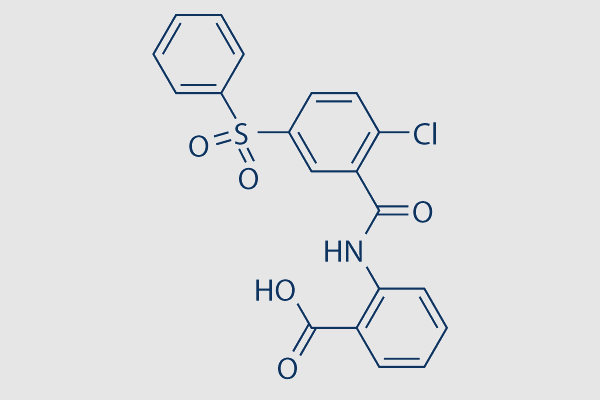
BAY-8002
SDS
COA
Ships within
Stock
Price
Qty
Total
$0.00
$0.00
Please click "REQUEST A QUOTE" button if you need other sizes or custom synthesis
request a quote
add to cart
add to cart
If there is no stock, or you need other sizes or custom synthesis, please:
request a quote
PRODUCTS SPECIFICATIONS [724440-27-1]
Store

Catalog
SLK-S8747
Brand
Selleck
CAS
724440-27-1
DESCRIPTION [724440-27-1]
Overview
MDL
MFCD05157149
Molecular Weight
415.85
Molecular Formula
C20H14ClNO5S
SMILES
O=C(O)C1=CC=CC=C1NC(C2=CC(S(=O)(C3=CC=CC=C3)=O)=CC=C2Cl)=O
For research use only.
Storage
3 years,-20°C,powder
1 years,-80°C,in solvent
Shipping
Room temperature shipping(Stability testing shows this product can be shipped without any cooling measures.)
Preparing Stock Solutions
Concentration
Volume
Mass
1 mg
5 mg
10 mg
1 mM
2.4047 mL
12.0236 mL
24.0471 mL
5 mM
0.4809 mL
2.4047 mL
4.8094 mL
10 mM
0.2405 mL
1.2024 mL
2.4047 mL
50 mM
0.0481 mL
0.2405 mL
0.4809 mL
Description
BAY-8002 is a novel inhibitor and potently suppress bidirectional lactate transport. BAY-8002 significantly increases intratumor lactate levels and transiently modulates pyruvate levels.
Targets
MCT
[1]
In vitro
BAY-8002 inhibits cellular SNARF-5 fluorescence change with an IC50 of 85 (±6) nmol/L in MCT1-expressing DLD-1 cells and displays excellent selectivity against MCT4 (IC50 > 50 μmol/L in EVSA-T cells). BAY-8002 is a dual inhibitor of MCT1 and MCT2.

References
[1] Quanz M, et al. Mol Cancer Ther. 2018, 17(11):2285-2296.