
[CAS NO. 956590-23-1] UNBS5162
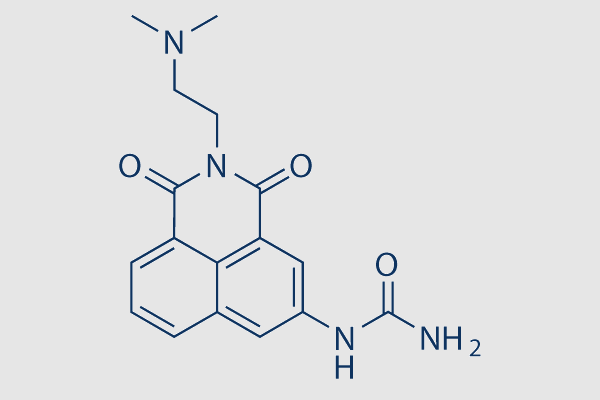
Please click "REQUEST A QUOTE" button if you need other sizes or custom synthesis
request a quote
If there is no stock, or you need other sizes or custom synthesis, please:
PRODUCTS SPECIFICATIONS [956590-23-1]
Store

Catalog
SLK-S8869
Brand
Selleck
CAS
956590-23-1
DESCRIPTION [956590-23-1]
Overview
| MDL | MFCD22380608 |
|---|---|
| Molecular Weight | 326.35 |
| Molecular Formula | C17H18N4O3 |
| SMILES | O=C(N)NC1=CC2=CC=CC(C(N(CCN(C)C)C3=O)=O)=C2C3=C1 |
For research use only.
Storage
3 years,-20°C,powder
1 years,-80°C,in solvent
1 years,-80°C,in solvent
Shipping
Room temperature shipping(Stability testing shows this product can be shipped without any cooling measures.)
Preparing Stock Solutions
| 1 mg | 5 mg | 10 mg | |
| 1 mM | 3.0642 mL | 15.3210 mL | 30.6419 mL |
| 5 mM | 0.6128 mL | 3.0642 mL | 6.1284 mL |
| 10 mM | 0.3064 mL | 1.5321 mL | 3.0642 mL |
| 50 mM | 0.0613 mL | 0.3064 mL | 0.6128 mL |
Description
UNBS5162 is a pan-antagonist of expression with in vitro cytotoxic activity (IC50 range of 0.5-5 µM) against a range of human cancer cell lines including glioblastoma (Hs683 and U373MG), colorectal (HCT-15 and LoVo), non-small-cell lung (A549) and breast (MCF-7).
Targets
| CXCL [1] |
In vitro
Exposure of PC-3 cells to UNBS5162 (1 µM for 5 successive days) dramatically decreases the expression of the proangiogenic CXCL chemokines. UNBS5162 displays weak in vitro antiproliferative activity with IC50 values of 17.3 μM, 16 μM, 4.7 μM, 8.5 μM, 28.8 μM, 8.9 μM, 46.5 μM, 21.2 μM, 9.1 μM in PC-3, DU-145, U373-MG, Hs683, HCT-15, LoVo, MCF-7, A549 and Bx-PC-3 cells. At 10 µM UNBS5162 markedly impairs PC-3 tumor cell growth kinetics, without inducing senescence, whereas the reverse feature is observed with respect to DU-145 cells. This difference might result from their respective p53 status and/or the extent of p16 expression. At 1 µM, UNBS5162 induces no such antitumor effects. UNBS5162 at 10 µM markedly increased the levels of heterochromatin in PC-3 cells through an increase in number of histones, at least at the mRNA levels. UNBS5162 has been identified to decrease levels of CXC chemokine ligand (CXCL) chemokines, including CXCL1, CXCL5 and CXCL8, in experimental prostate cancer and has a good inhibitory effect on the proliferation of tumour cells in vitro and in vivo. It inhibits cell proliferation, invasion and migration, and promote cell apoptosis, potentially through the PI3K/AKT signalling pathway in SKOV3 ovarian cancer cells.
References

Powered by Arctom Copyright © 2026 Arctom. All rights
reserved.