
ATTRIBUTES
Store

Catalog
CD-SL-000197
Brand
ChemDiv
OVERVIEW
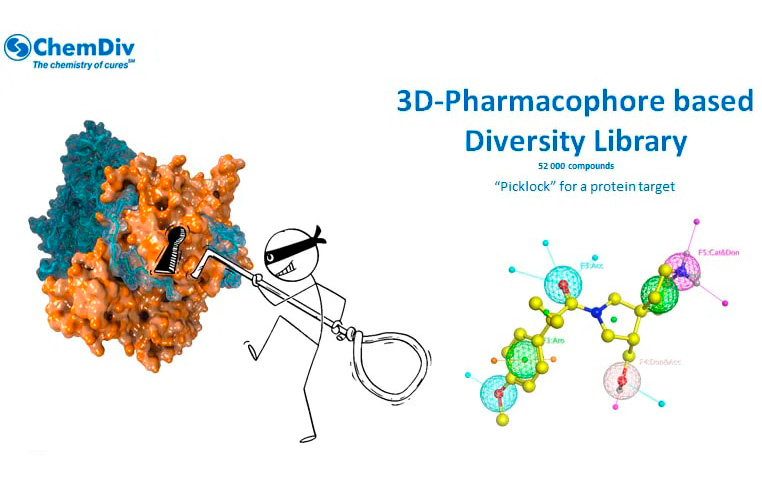
ChemDiv's 3D-Pharmacophore Based Diversity Library contains 52,000 compounds.
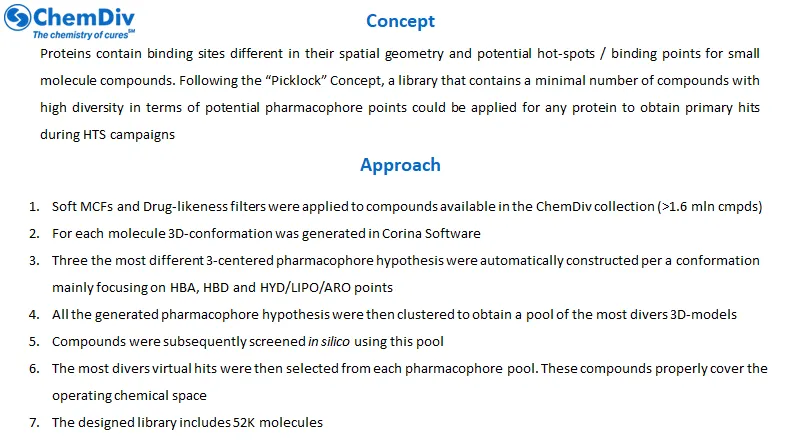
Pour proprietary 3D-Pharmacophore Based Diversity Library is designed to maximize the efficiency and efficacy of hit identification during high-throughput screening (HTS) campaigns for various protein targets. This library is constructed using a strategic approach that leverages the diverse spatial geometries and potential interaction points within protein binding sites, adhering to the "Picklock" Concept. This concept aims to create a library with a minimal yet highly diverse set of compounds, each rich in potential pharmacophore points such as hydrogen bond acceptors (HBA), hydrogen bond donors (HBD), and hydrophobic/lipophilic/aromatic (HYD/LIPO/ARO) points. Such a design ensures that the library can engage with any protein target to yield primary hits effectively.
The development process of this library involves several meticulous steps to refine and enhance the selection of compounds:
- Application of Soft Molecular Complexity Filters (MCFs) and drug-likeness filters to over 1.6 million compounds from the ChemDiv collection ensures that only compounds with favorable pharmacokinetic and pharmacodynamic properties are considered.
- Utilization of Corina Software to generate accurate 3D conformations for each molecule, providing a realistic basis for further analysis.
- Automated construction of three distinct 3-centered pharmacophore hypotheses for each conformation, focusing on critical pharmacophore features like HBA, HBD, and HYD/LIPO/ARO.
- Clustering of all generated pharmacophore hypotheses to form a pool of the most diverse 3D models, which represent a wide array of molecular interactions.
- In silico screening of compounds using this diverse pharmacophore model pool to identify those that best fit the hypothetical pharmacophore structures.
- Selection of the most diverse virtual hits from each pharmacophore cluster, ensuring that the selected compounds comprehensively cover the operational chemical space and are likely to interact effectively with target proteins.
Our highly curated library that not only facilitates the discovery of novel leads against challenging targets but also enhances the likelihood of success in subsequent optimization and development phases. This library stands as a critical tool in drug discovery, providing a strategic advantage in identifying leads that are both effective against specific protein targets and amenable to further development into therapeutic agents.
It offers significant benefits for drug discovery researchers by providing a highly curated set of small molecules optimized for interaction with diverse protein targets. Its strategic construction allows for efficient and effective high-throughput screening, enhancing the probability of identifying novel, potent leads. The library's design, focusing on diverse pharmacophore features—such as hydrogen bond acceptors, donors, and hydrophobic points—ensures comprehensive coverage of the chemical space and potential binding sites, which is crucial for tackling proteins with complex and varied binding geometries. Moreover, the use of sophisticated software for 3D conformation generation and pharmacophore hypothesis construction enables the library to support targeted and mechanism-based screening campaigns, ultimately speeding up the lead discovery process and reducing the cost and time associated with downstream development phases. This makes the library an invaluable resource for researchers aiming to rapidly expand their discovery pipeline and enhance the development of new therapeutic agents with high specificity and efficacy.

Powered by Arctom Copyright © 2026 Arctom. All rights
reserved.