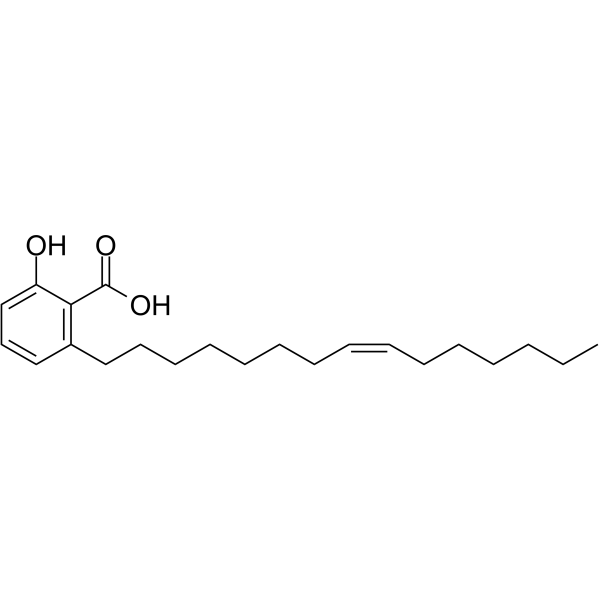
[CAS NO. 22910-60-7] Ginkgolic Acid
PRODUCTS SPECIFICATIONS [22910-60-7]

DESCRIPTION [22910-60-7]
Overview
| MDL | MFCD03093717 |
|---|---|
| Molecular Weight | 346.50 |
| Molecular Formula | C22H34O3 |
| SMILES | O=C(O)C1=C(CCCCCCC/C=C\CCCCCC)C=CC=C1O |
9 Publications Citing Use of MCE
- [1]Nat Commun. 2022 Sep 3;13(1):5204.
- [2]Mol Ther Oncolytics. 2019 Dec 14;16:86-99.
- [3]Microbiol Spectr. 2022 Jan 12;e0099121.
- [4]Toxicol Appl Pharmacol. 2018 Apr 15;345:1-9.
- [5]Placenta. 2022.
- [6]J Med Food. 2021 Aug 11.
- [7]Scienceasia. 2020 Dec.
- [8]Research Square Preprint. 2021 Jan.
- [9]Patent. US20200368199A1.
Summary
Ginkgolic Acid is a natural compound that inhibits SUMOylation with an IC 50 of 3.0 μM in in vitro assay.
IC50 & Target
IC50: 3.0 μM (SUMOylation) [1]
In Vitro
Ginkgolic acid inhibits the in vitro SUMOylation of RanGAP1-C2 with the IC 50 values of 3.0 μM. The level of SUMOylated p53 is markedly reduced by the ginkgolic acid treatment. Importantly, ginkgolic acid does not affect protein ubiquitination in cells. Ginkgolic acid inhibits the binding between E1 and GA-BODIPY in a dose-dependent manner [1] . Ginkgolic acid (31.2 μg/mL) inhibits HIV protease activity by 60%, compared with the negative control, and the effect is concentration-dependent. Ginkgolic acid treatment (50 and 100 μg/mL) effectively inhibits HIV infection in human PBMC cells. Ginkgolic acid at the concentrations up to 150 μg/mL does not cause any significant cytotoxicity in Jurkat cells [2] . GA only inhibits the growth of tumorogenic cell lines in a both dose- and time-dependent manner. Tumor cells are treated with GA for 72 h, 70.53±4.54% Hep-2 and 63.5±7.2% Tca8113 cells are retarded at GO/G1 phase, and the percentage of apoptosis is 40.4±1.58 and 38.4±1.7%, respectively. GA-treated activated caspase-3 downregulates the expression of anti-apoptotic Bcl-2 protein and upregulates the expression of pro-apoptotic Bax protein, eventually leading to a decrease in the Bcl-2/Bax ratio in tumor cellsin human PBMC cells. Ginkgolic acid at the concentrations up to 150 μg/mL does not cause any significant cytotoxicity in Jurkat cells [3] .
MCE has not independently confirmed the accuracy of these methods. They are for reference only.
Appearance
Solid
Source
Shipping
Room temperature in continental US; may vary elsewhere.
Storage
| Powder | -20°C | 3 years |
|---|---|---|
| 4°C | 2 years | |
| In solvent | -80°C | 6 months |
| -20°C | 1 month |
Solvent & Solubility
DMSO : 100 mg/mL ( 288.60 mM ; Need ultrasonic)
Stock Solutions
| Concentration Solvent Mass | 1 mg | 5 mg | 10 mg |
|---|
| 1 mM | 2.8860 mL | 14.4300 mL | 28.8600 mL |
| 5 mM | 0.5772 mL | 2.8860 mL | 5.7720 mL |
| 10 mM | 0.2886 mL | 1.4430 mL | 2.8860 mL |
-
1.
-
2.
Add each solvent one by one: 10% DMSO >> 90% corn oil
Solubility: ≥ 2.75 mg/mL (7.94 mM); Clear solution
References
- [1] Fukuda I, et al. Ginkgolic acid inhibits protein SUMOylation by blocking formation of the E1-SUMO intermediate. Chem Biol. 2009 Feb 27;16(2):133-40.
- [2] Lü JM, et al. Ginkgolic acid inhibits HIV protease activity and HIV infection in vitro. Med Sci Monit. 2012 Aug;18(8):BR293-298.
- [3] Zhou C, et al. Antitumor effects of ginkgolic acid in human cancer cell occur via cell cycle arrest and decrease the Bcl-2/Bax ratio to induce apoptosis. Chemotherapy. 2010;56(5):393-402.
- [4] Qiu F, et al. Pharmacological inhibition of SUMO-1 with ginkgolic acid alleviates cardiac fibrosis induced by myocardial infarction in mice. Toxicol Appl Pharmacol. 2018 Apr 15;345:1-9.
Synonyms