
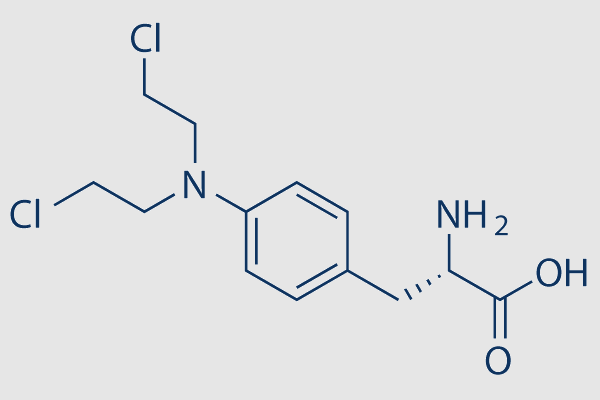
[CAS NO. 148-82-3] Melphalan
Please click "REQUEST A QUOTE" button if you need other sizes or custom synthesis
request a quote
If there is no stock, or you need other sizes or custom synthesis, please:
PRODUCTS SPECIFICATIONS [148-82-3]
Store

Catalog
SLK-S8266
Brand
Selleck
CAS
148-82-3
DESCRIPTION [148-82-3]
Overview
| MDL | - |
|---|---|
| Molecular Weight | 305.20 |
| Molecular Formula | C13H18Cl2N2O2 |
| SMILES | N(CCCl)(CCCl)C1=CC=C(C[C@@H](C(O)=O)N)C=C1 |
For research use only.
Storage
3 years,-20°C,powder
1 years,-80°C,in solvent
1 years,-80°C,in solvent
Shipping
Room temperature shipping(Stability testing shows this product can be shipped without any cooling measures.)
Preparing Stock Solutions
| 1 mg | 5 mg | 10 mg | |
| 1 mM | 3.2765 mL | 16.3827 mL | 32.7654 mL |
| 5 mM | 0.6553 mL | 3.2765 mL | 6.5531 mL |
| 10 mM | 0.3277 mL | 1.6383 mL | 3.2765 mL |
| 50 mM | - | - | - |
Description
Melphalan (Alkeran, Sarcolysin, L-PAM) is a phenylalanine derivative of nitrogen mustard with antineoplastic activity.
In vitro
Exposure of a myeloma cell line (RPMI 8226) to a 30-minute pulse of melphalan (1-phenylalanine-mustard) results in a cell cycle progression delay characteristic for DNA cross-linking agents. Melphalan has been shown to bind to DNA, RNA, and protein in cells in vitro. Melphalan induces chromosomal aberrations, sister chromatid exchange, micronuclei, mutations at the HPRT gene, and DNA damage in human cells in vitro. It also induces transformation of C3H 10T1/2 and other cells. In cultured rodent cells, it induces chromosomal aberrations, sister chromatid exchange, gene mutations, and DNA damage. In addition, it induces aneuploidy and sex-linked recessive lethal mutations in Drosophila, and mutation in bacteria.
In vivo
Melphalan has been tested in mice by oral, intraperitoneal, and dermal application; in rats by intraperitoneal injection, and in monkeys by oral administration. In mice, the administration of melphalan produced forestomach papillomas, lymphosarcomas, and skin and lung tumours. In rats, melphalan caused mammary gland tumours, and peritoneal sarcomas. Results in monkeys were inconclusive.
References
Synonyms
L-Phenylalanine, 4-[bis(2-chloroethyl)amino]-
Alanine, 3-[p-[bis(2-chloroethyl)amino]phenyl]-, L-
4-[Bis(2-chloroethyl)amino]-L-phenylalanine
CB 3025
NSC 8806
Alkeran
Melphalan
L-Sarcolysin
L-Sarkolysin
L-Sarcolysine
L-Phenylalanine mustard
Phenylalanine mustard
3025CB
L-PAM
Levofalan
Levofolan
Levopholan
Alanine nitrogen mustard
Melfalan
Sarcoclorin
L-Phenylalanine mustard hydrochloride
NSC 241286
67: PN: WO2010011890 PAGE: 37 claimed protein

Powered by Arctom Copyright © 2026 Arctom. All rights
reserved.